This year, Ramadhan is expected to start on the evening of Friday, February 28, 2025. It will end with Eid al-Fitr, which begins the month of Shawwal in the Islamic calendar. Ramadan is anticipated to conclude on Sunday, March 30, 2025, depending on the moon sighting.
If Allah wills, (Insha’Allah) I will present on this page some of the awe-inspiring signs of Allah from the Quran for the special month of Ramadhan, a time of reflection, spirituality, and community. During this blessed month, Muslims around the world engage in fasting, which serves not only as a means of physical discipline but also as a profound spiritual practice that enhances one’s connection to Allah. It is a period for deepening faith, performing acts of charity, and purging the soul of distractions.
Before presenting these divine signs, let me share five specific Ayaat (Verses), each highlighting different aspects of fasting and its significance in fostering spiritual growth, self-restraint, and empathy towards those in need. Below are these verses along with their translations, each offering insights into the essence of fasting and the rich teachings embedded within the Quran.
Surah Al-Baqarah Ayah 183
1/Quran: يَٰٓأَيُّهَا ٱلَّذِينَ ءَامَنُوا۟ كُتِبَ عَلَيْكُمُ ٱلصِّيَامُ كَمَا كُتِبَ عَلَى ٱلَّذِينَ مِن قَبْلِكُمْ لَعَلَّكُمْ تَتَّقُونَ
Translation: “O you who have believed, decreed upon you is fasting as it was decreed upon those before you that you may become righteous”
Surah Al-Baqarah Ayah 184
2/Quran: أَيَّامًا مَّعْدُودَٰتٍ ۚ فَمَن كَانَ مِنكُم مَّرِيضًا أَوْ عَلَىٰ سَفَرٍ فَعِدَّةٌ مِّنْ أَيَّامٍ أُخَرَ ۚ وَعَلَى ٱلَّذِينَ يُطِيقُونَهُۥ فِدْيَةٌ طَعَامُ مِسْكِينٍ ۖ فَمَن تَطَوَّعَ خَيْرًا فَهُوَ خَيْرٌ لَّهُۥ ۚ وَأَن تَصُومُوا۟ خَيْرٌ لَّكُمْ ۖ إِن كُنتُمْ تَعْلَمُونَ
Translation: “[Fasting for] a limited number of days. So whoever among you is ill or on a journey [during them] – then an equal number of days [are to be made up]. And upon those who are able [to fast, but with hardship] – a ransom [as substitute] of feeding a poor person [each day]. And whoever volunteers excess – it is better for him. But to fast is best for you, if you only knew.”
Surah Al-Baqarah Ayah 185
3/Quran: شَهْرُ رَمَضَانَ ٱلَّذِىٓ أُنزِلَ فِيهِ ٱلْقُرْءَانُ هُدًى لِّلنَّاسِ وَبَيِّنَٰتٍ مِّنَ ٱلْهُدَىٰ وَٱلْفُرْقَانِ ۚ فَمَن شَهِدَ مِنكُمُ ٱلشَّهْرَ فَلْيَصُمْهُ ۖ وَمَن كَانَ مَرِيضًا أَوْ عَلَىٰ سَفَرٍ فَعِدَّةٌ مِّنْ أَيَّامٍ أُخَرَ ۗ يُرِيدُ ٱللَّّهُ بِكُمُ ٱلْيُسْرَ وَلَا يُرِيدُ بِكُمُ ٱلْعُسْرَ وَلِتُكْمِلُوا۟ ٱلْعِدَّةً وَلِتُّكَبِّرُوا۟ ٱللَّه على ما هَدَىٰكُمْ وَلَعَلَّكُمْ تَقْمُلُون.
Translation: “The month of Ramadhan [is that] in which was revealed the Qur’an, a guidance for the people and clear proofs of guidance and criterion. So whoever sights [the new moon of] the month, let him fast it; and whoever is ill or on a journey – then an equal number of other days. Allah intends for you ease and does not intend for you hardship and [wants] for you to complete the period and to glorify Allah for that [to] which He has guided you; and perhaps you will be grateful.”
Surah Al-Baqarah Ayah 187
4/Quran: أُحِلَّ لَّكُمْ لَيْلَةً رَمَدَا ن الرَّفث إلى نِّسائكم ۚ هُنَّ لِباسٌ لَّكُمْ وَأَنْتُمْ لِباسٌ لَّهُنَّ ۗ عَلَم اللَّه أنكم كنتم تخانون أنفسكم فاتاب عليكم وعفا عنكم ۖ فالآن باشروهن وابتغوا ما كتب اللَّه لكم ۚ وكلوا واشربوا حتى يتبين لكم الخيط الأبيض من الخيط الأسود من الفجر ۖ ثم أتموا الصيام إلى الليل ۚ ولا تباشروهن وأنتم عاكفون في المساجد ۚ تلك حدود اللَّه فلا تقربوها ۚ كذلك يبين اللَّه آياته للناس لعلكم تتقون.
Translation: “It has been made permissible for you the night preceding fasting to go to your wives [for sexual relations]. They are clothing for you and you are clothing for them. Allah knows that you used to deceive yourselves, so He accepted your repentance and forgave you. So now, have relations with them and seek that which Allah has decreed for you. And eat and drink until the white thread of dawn becomes distinct to you from the black thread [of night]. Then complete the fast until the sunset. And do not have relations with them as long as you are staying for worship in the mosques. These are the limits [set by] Allah , so do not approach them. Thus does Allah make clear His ordinances to the people that they may become righteous.”
Surah Al-Qadr Ayat 1-5
5/Quran:إِنَّآ أَنزَلۡنَـٰهُ فِى لَيۡلَةِ ٱلۡقَدۡرِ (١) وَمَآ أَدۡرَٮٰكَ مَا لَيۡلَةُ ٱلۡقَدۡرِ (٢) لَيۡلَةُ ٱلۡقَدۡرِ خَيۡرٌ۬ مِّنۡ أَلۡفِ شَہۡرٍ۬ (٣) تَنَزَّلُ ٱلۡمَلَـٰٓٮِٕكَةُ وَٱلرُّوحُ فِيہَا بِإِذۡنِ رَبِّہِم مِّن كُلِّ أَمۡرٍ۬ (٤) سَلَـٰمٌ هِىَ حَتَّىٰ مَطۡلَعِ ٱلۡفَجۡرِ (٥)
Translation: “Indeed, We sent the Qur’an down during the Night of Decree. And what can make you know what is the Night of Decree? The Night of Decree is better than a thousand months. The angels and the Spirit descend therein by permission of their Lord for every matter. Peace it is until the emergence of dawn.”
These verses collectively emphasize fasting’s purpose, its timing during Ramadan, its spiritual significance, and its connection to self-restraint, righteousness (taqwa), charity, and reflection
Let’s begin with beautiful topics for this sacred month.
TOPIC NUMBER 1-Symmetry
Symmetry refers to a situation where two parts are mirror images of each other. In linguistics, this can often relate to how words or phrases are structured. For example, think about the word “mom.” If you look at it from both ends, it looks the same: “m-o-m.” This is a simple example of symmetry because if you fold the word in half, both sides match perfectly.
Another example could be in sentences. Consider the sentence: “The cat chased the mouse, and the mouse chased the cat.” Here, there is a symmetry in meaning; both parts of the sentence reflect each other’s actions.
Now let’s see Symmetry in the Quran from the Ayat (Verse) Number 255 of Chapter Number 2 of the Quran:
ٱللَّهُ لَآ إِلَـٰهَ إِلَّا هُوَ ٱلۡحَىُّ ٱلۡقَيُّومُۚ لَا تَأۡخُذُهُ ۥ سِنَةٌ۬ وَلَا نَوۡمٌ۬ۚ لَّهُ ۥ مَا فِى ٱلسَّمَـٰوَٲتِ وَمَا فِى ٱلۡأَرۡضِۗ مَن ذَا ٱلَّذِى يَشۡفَعُ عِندَهُ ۥۤ إِلَّا بِإِذۡنِهِۦۚ يَعۡلَمُ مَا بَيۡنَ أَيۡدِيهِمۡ وَمَا خَلۡفَهُمۡۖ وَلَا يُحِيطُونَ بِشَىۡءٍ۬ مِّنۡ عِلۡمِهِۦۤ إِلَّا بِمَا شَآءَۚ وَسِعَ كُرۡسِيُّهُ ٱلسَّمَـٰوَٲتِ وَٱلۡأَرۡضَۖ وَلَا يَـُٔودُهُ ۥ حِفۡظُهُمَاۚ وَهُوَ ٱلۡعَلِىُّ ٱلۡعَظِيمُ (٢٥٥)
Translation: Allah – there is no deity except Him, the Ever-Living, the Sustainer of [all] existence. Neither drowsiness overtakes Him nor sleep. To Him belongs whatever is in the heavens and whatever is on the earth. Who is it that can intercede with Him except by His permission? He knows what is [presently] before them and what will be after them, and they encompass not a thing of His knowledge except for what He wills. His Kursi extends over the heavens and the earth, and their preservation tires Him not. And He is the Most High, the Most Great.
This verse is lengthy and has balanced sections. Refer to the photograph below for clarity.
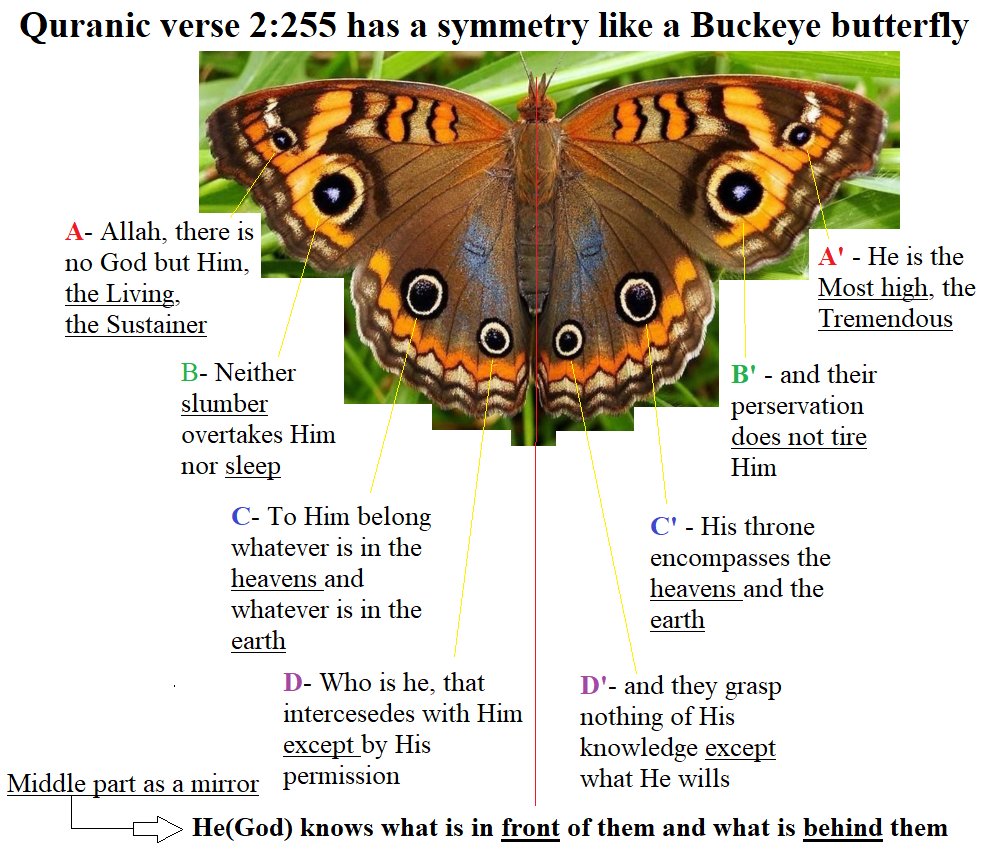
The first section mirror the last section and the second section mirror the second from the last section and so on in an opposite way. The 4 sections mirror each other as on the photo. In other words the meaning of the first section is the same as the last section and so on. And the middle section act like a mirror. The meaning of the middle section is also pointing the front and rear sections. Do you see the sign of Allah from this great beautiful Verse which when you recite it can give you security and so many benefits in the life. Allah Knows Best.
TOPIC NUMBER 2-Concentric
Concentric refers to shapes or patterns that share a common centre but have different sizes. In linguistics, we can think about concentric circles as layers of meaning or context around a word. For instance, imagine you have a circle drawn on paper. The center of that circle represents the core meaning of a word like “home.” As you move outward in concentric circles, you might find related meanings: family (the first circle), comfort (the second circle), and safety (the third circle). Each layer expands on what “home” means but stays connected to its central idea.
Now let’s see Concentric in the Quran from the below Diagram:
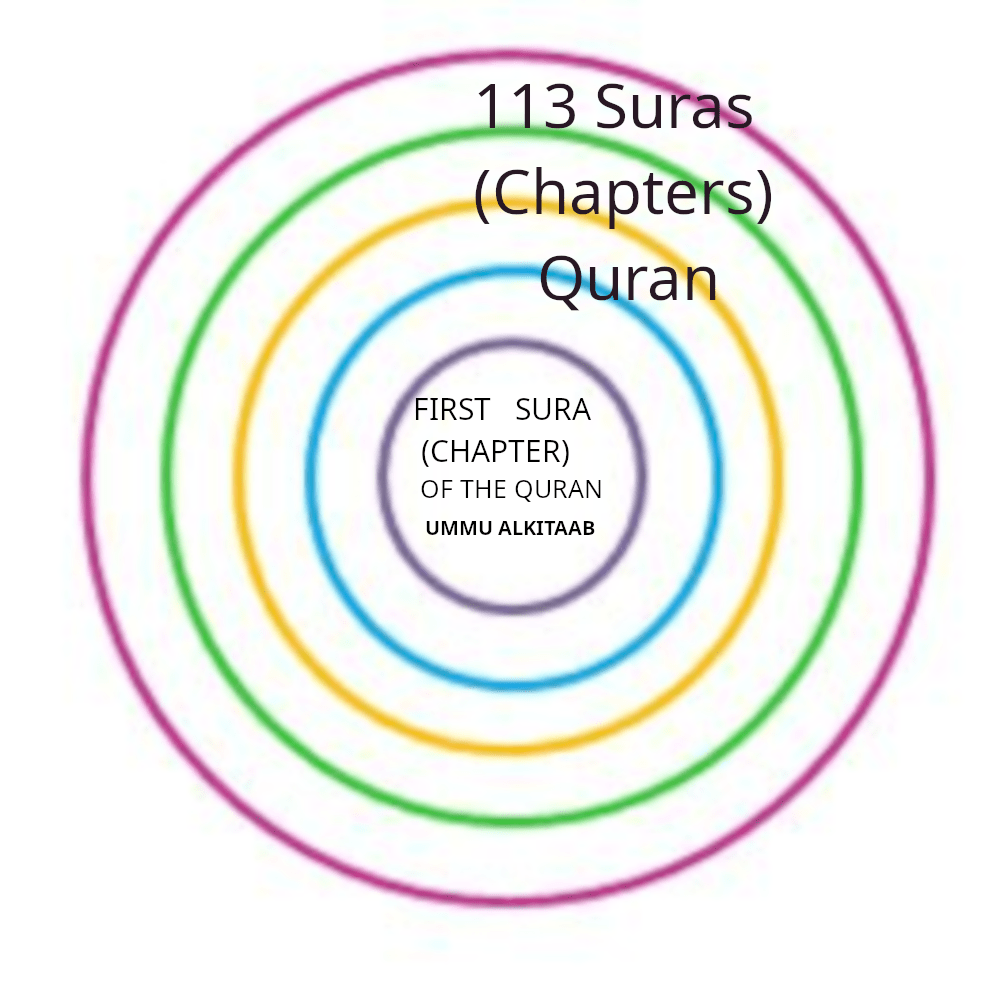
Surat Al-Fatiha, which is Chapter Number 1 of the Quran, is revered as the Mother of the Quran due to its profound significance and multifaceted role within the Islamic faith. It serves not only as an essential supplication but also encapsulates the essence of the entire Quran in its verses.
Specifically, in Ayat or verse number 6 of this Chapter, we earnestly implore Allah for guidance, stating
“Guide us to the straight path.”
This invocation is not merely a request but a deep acknowledgment of our dependence on divine direction.
Transitioning into the subsequent Chapter, known as Al-Baqarah, Allah clearly articulates the importance of the Quran as a source of guidance in Verse number 2, Allah says:
“This is the Book about which there is no doubt, a guidance for those conscious of Allah.”
Hence, Chapter Number 1 is referred to as Ummu Al-Kitab, or the Mother of the Book, signifying its foundational role in its thematic topic
The Quran itself consists of 114 Chapters, and within this arrangement, Chapter One emerges with a central theme of guidance, intertwining profoundly with teachings derived from the other 113 Chapters.
Each of these Chapters acts as a vital limb, collectively contributing to the holistic understanding and application of guidance.
Muslim scholars articulate that all of the Quran is contained within this First Chapter, and they emphasize that the essence of the First Chapter can be found even within its very first Ayat.
The initial Ayat states:
“In the name of Allah, the Entirely Merciful, the Especially Merciful,”
implying that through Allah’s infinite mercy, we are bestowed with guidance, fostering a deeper comprehension when we apply the teachings outlined in the Chapters.
To visualize this, one can consider it akin to a tree, with Allah’s blessings and mercy acting as the roots that nourish our pursuit of guidance through Chapter number one; this guidance, in turn, draws upon the teachings embodied in the remaining 113 Chapters, forming a cohesive and enriching framework.
The central theme of guidance circulates through every aspect, while the teachings around it provide essential insights and wisdom connected to this core. Allah Knows Best.
TOPIC NUMBER 3-THE SPIDER
SCIENCE AND QURAN
SCIENCE 20th CENTURY
Discovery of Female Spider Web Construction
The understanding that female spiders are primarily responsible for web construction has evolved over time, with significant contributions from various studies in arachnology. Historically, it was observed that many spider species exhibit sexual dimorphism, where females are generally larger than males. This size difference often led to the assumption that females would take on more significant roles in web building and prey capture.
Early Observations and Studies
In the early 20th century, researchers began to document the behaviors of different spider species more systematically. Notably, studies conducted by biologists such as A. E. McCook in the late 1800s and early 1900s provided insights into the behavior of orb-weaving spiders. McCook’s observations highlighted that female spiders were indeed the primary builders of webs, particularly in species like those belonging to the family Araneidae.
Modern Research and Confirmation
By the mid-20th century, further research solidified this understanding. Studies using behavioral observations and controlled experiments confirmed that female spiders not only construct webs but also maintain them and use them for hunting. For example, research published in journals such as “Animal Behaviour” and “Journal of Arachnology” during the latter half of the 20th century provided detailed accounts of web-building behaviors specific to female spiders across various species.
Additionally, it became clear that while male spiders may assist in web maintenance or contribute to mating displays within a web context, they do not typically engage in web construction. This distinction has been crucial for understanding spider ecology and behavior.
Conclusion
Thus, while early observations hinted at this behavior, it was through systematic study and documentation throughout the 20th century that it became widely accepted within the scientific community that the female spider is primarily responsible for building webs.
- Animal Behaviour: A peer-reviewed journal focusing on animal behavior research which includes studies on arachnid behavior.
- Journal of Arachnology: A specialized journal dedicated to arachnology that publishes research on all aspects of spider biology including web construction.
- A.E. McCook’s Works: Early foundational texts on spider behavior which documented observations regarding female spiders’ roles in web building.
PHOTOS
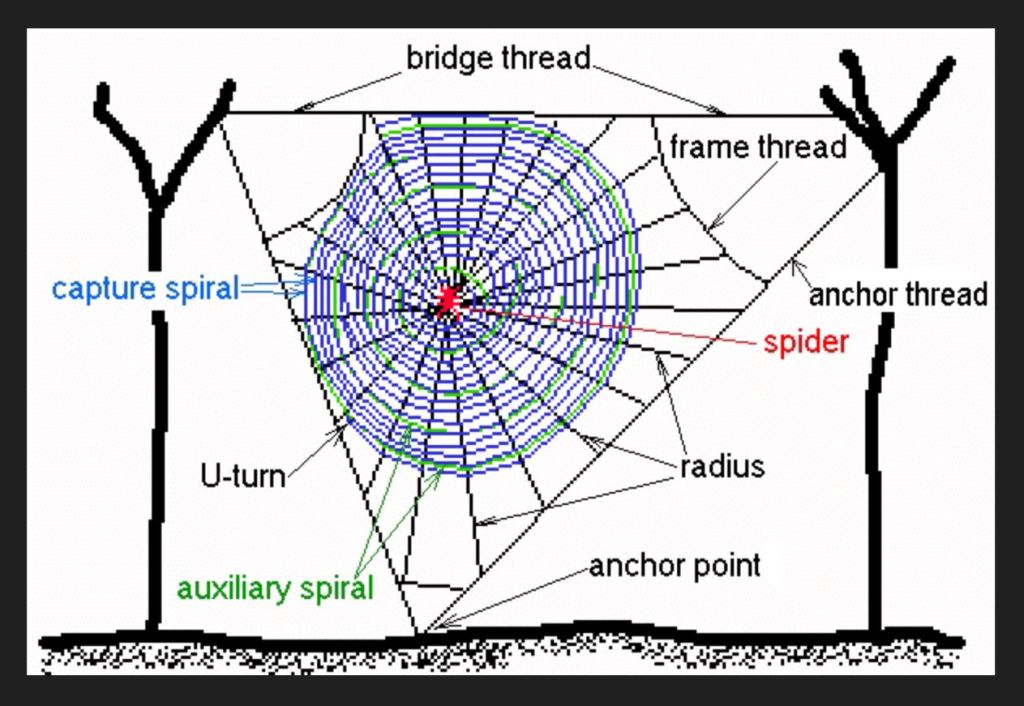
The below Photos shows various designs of the spiders’ web. This is just one example from several which shows how much knowledge we still don’t know.

Let’s now move to the Quran.
QURAN-7TH CENTURY
QURAN-Al-ANJABOOT CHAPTER 29 VERSE 41
مَثَلُ ٱلَّذِينَ ٱتَّخَذُواْ مِن دُونِ ٱللَّهِ أَوۡلِيَآءَ كَمَثَلِ ٱلۡعَنڪَبُوتِ ٱتَّخَذَتۡ بَيۡتً۬اۖ وَإِنَّ أَوۡهَنَ ٱلۡبُيُوتِ لَبَيۡتُ ٱلۡعَنڪَبُوتِۖ لَوۡ ڪَانُواْ يَعۡلَمُونَ (٤١)
TRANSLATION:
The parable of those who take Auliya’ (protectors and helpers) other than Allah is as the likeness of a spider, who builds (for itself) a house, but verily, the frailest (weakest) of houses is the spider’s house; if they but knew.
Understanding the Feminine Usage of عَنْكَبُوْتٌ in the Quran-English Sources
The word عَنْكَبُوْتٌ (ankabut), which translates to “spider,” is grammatically feminine in Arabic. This classification can be understood through several linguistic and contextual factors.
1. Grammatical Gender in Arabic: In Arabic, nouns are categorized into masculine and feminine genders. The gender of a noun does not always correlate with biological sex; rather, it is a grammatical feature. The word عَنْكَبُوْتٌ is treated as feminine due to its morphological structure and the conventions of the Arabic language.
2. Linguistic Convention: The classification of certain animals as feminine is common in Arabic. For example, many insects and creatures that do not have a clear male or female distinction are often assigned a feminine gender. This convention allows for consistency within the language, where certain categories of nouns are inherently feminine.
3. Contextual Usage in the Quran: In the Quran, عَنْكَبُوْتٌ appears in Surah Al-Ankabut (Chapter 29), where it serves as part of a metaphorical illustration regarding weakness and fragility. The use of a feminine noun can also enhance the poetic and rhetorical aspects of the text, contributing to its eloquence and depth.
4. Symbolism Associated with Femininity: In many cultures, including Arabic culture, femininity is often associated with concepts such as nurturing and fragility. By using a feminine term for spider, it may symbolize vulnerability or weakness, aligning with the message conveyed in Surah Al-Ankabut about those who take protectors other than Allah being like spiders weaving fragile webs.
5. Consistency Across Translations: Translations of the Quran maintain this grammatical gender when referring to عَنْكَبُوْتٌ, reflecting its original usage in Arabic while conveying similar meanings across different languages.
In summary, the Quran uses the word عَنْكَبُوْتٌ as feminine due to grammatical conventions in Arabic that classify certain nouns as feminine regardless of biological characteristics, along with contextual symbolism that enhances its rhetorical impact within the text.
- Al-Mawardi’s “Nihayat al-Darab fi al-Nahw”: A classical work on Arabic grammar that discusses gender classifications among nouns.
- Ibn Manzur’s “Lisan al-Arab”: An extensive dictionary of the Arabic language that provides insights into word origins and grammatical rules.
- Al-Jurjani’s “Dalail al-I’jaz”: A study on eloquence in the Quran that explores linguistic features and their implications within Islamic texts
Understanding the Feminine Usage of عَنْكَبُوْتٌ in the Quran-Arabic Sources
اسم العنكبوت الأنثوي في اللغة العربية
في اللغة العربية، يُستخدم مصطلح “عنكبوت” للإشارة إلى كائن العنكبوت بشكل عام، ولكن هناك تمييز بين الذكر والأنثى. حيث يُطلق على الذكر اسم “عنكب”، بينما يُشار إلى الأنثى باسم “عنكبوت”.
التمييز بين الجنسين
- الذكر (عنكب): هو الاسم المستخدم للإشارة إلى الذكور من العناكب.
- الأنثى (عنكبوت): هو الاسم المستخدم للإشارة إلى الإناث من العناكب.
هذا التمييز يعكس الفروق البيولوجية بين الجنسين في عالم العناكب، حيث أن الإناث غالبًا ما تكون أكبر حجمًا وتلعب دورًا رئيسيًا في بناء الشبكات وصيد الفرائس.
أهمية هذا التمييز
فهم هذه الأسماء يساعد في توضيح المعلومات المتعلقة بالعناكب ودورها في النظام البيئي، حيث أن الإناث عادةً ما تكون هي التي تبني الشبكات وتقوم بالصيد.
الخلاصة
إذن، الاسم المستخدم للأنثى في اللغة العربية هو “عنكبوت”.
- معجم المعاني الجامع: قاموس شامل يحتوي على تعريفات دقيقة للكلمات والمصطلحات باللغة العربية.
- قاموس اللغة العربية المعاصر: مصدر موثوق يقدم معاني الكلمات وتعريفاتها بطريقة حديثة ومبسطة.
- معجم الشهابي في مصطلحات العلوم الزراعية: مرجع متخصص يتناول المصطلحات العلمية بما فيها تلك المتعلقة بالحشرات والعناكب.
This is a miracle itself; the 7th Century Quran states that it is the female spider that builds the web, not the male and it’s the 20th scientific discovery!!!!!! Where did Prophet Mohamad learn this information? This is a clear proof that the Quran message is from the creator-Allah
Topic Number 4 soon If Allah Wills……………….
 SCIENTIFIC AND ISLAMIC RESEARCHES