The Sciences of the Quran (Ulum al-Qur’an) encompass a wide range of disciplines that focus on various aspects of the Quran, its recitation, interpretation, and historical context. These sciences are essential for a comprehensive understanding of the Quran and its application in Islamic life.
Key Branches of the Sciences of the Quran
Tafsir (Exegesis): This is the science dedicated to explaining and interpreting the meanings of the verses of the Quran. Tafsir seeks to clarify ambiguous terms, provide context for revelations, and derive legal rulings from the text.
Grammar and Morphology: This branch studies the linguistic structure of Arabic as it appears in the Quran. It includes understanding syntax, morphology, and phonetics to ensure accurate recitation and comprehension.
Rhetoric: The study of rhetorical devices used in the Quran helps in understanding how language is employed to convey messages effectively. This includes analysing metaphors, similes, and other figures of speech. Metrics Science examines forms and literary styles present in the Quranic text. It looks at stylistic elements that contribute to its literary beauty.
Science of Recitations (Qira’at): This involves studying different accepted readings of the Quran. Each reading may have slight variations in pronunciation or wording that can complete but not change the meaning.
Hadith Studies: While primarily focused on sayings and actions of Prophet Muhammad (peace be upon him), this science intersects with Quranic studies by providing context for certain verses through prophetic traditions. They complete and clarify some of the Quranic Verses.
Fiqh Science: This branch deals with deriving legal rulings from both the Quran and Hadith. It focuses on how Islamic law is informed by these texts.
Asbab al-Nuzul (Causes of Revelation): Understanding why specific verses were revealed helps contextualize their meanings and applications within Islamic teachings.
Ghareeb al-Qur’an (Unique Words): This field focuses on identifying rare or unusual words found in the Quran, exploring their meanings and implications for interpretation.
Abrogation (Naskh): This science studies which verses have been abrogated or replaced by later revelations, helping scholars understand changes in legal rulings over time.
Tajweed: Tajweed is the science of properly pronouncing and articulating the letters and words of the Quran according to specific rules. This discipline is essential for ensuring that each letter is pronounced correctly, preserving the meaning and beauty of the Quranic text
Importance of Studying Sciences of the Quran
Studying these sciences provides Muslims with a deeper appreciation for their faith by enhancing their understanding of religious texts, enabling them to defend against misconceptions, derive legal rulings accurately, and apply teachings effectively in daily life.
In summary, the Sciences of the Quran include Tafsir, Grammar and Morphology, Rhetoric, Science of Recitations (Qira’at), Hadith Studies, Fiqh Science, Asbab al-Nuzul (Causes of Revelation), Ghareeb al-Qur’an (Unique Words), and Abrogation (Naskh).
1/TAJWEED
Here’s a step-by-step breakdown of Tajweed sciences:
Definition of Tajweed
Tajweed (تجويد) comes from the Arabic root word “جود” (J-W-D), which means to improve or make better. In the context of Quranic recitation, it refers to enhancing the way the Quran is read by ensuring accurate pronunciation, articulation, and rhythm.
Importance of Tajweed
1/Preservation of Meaning: Mispronouncing words can alter their meanings, making Tajweed crucial for maintaining the integrity of the Quran.
2/Spiritual Connection: Reciting with Tajweed enhances one’s spiritual experience and connection with Allah.
3/Linguistic Proficiency: It improves understanding of Arabic phonetics and grammar, allowing for deeper engagement with the text.
Key Components of Tajweed
- Makharij al-Huruf (Articulation Points)
This refers to the specific points in the mouth, throat, or tongue where each Arabic letter is produced. Mastery of these articulation points ensures clear and accurate recitation. - Sifat al-Huruf (Attributes of Letters)
These are inherent qualities that distinguish one letter from another, such as whether a letter is voiced or voiceless, heavy or light. - Ahkam al-Tajweed (Rules of Recitation)
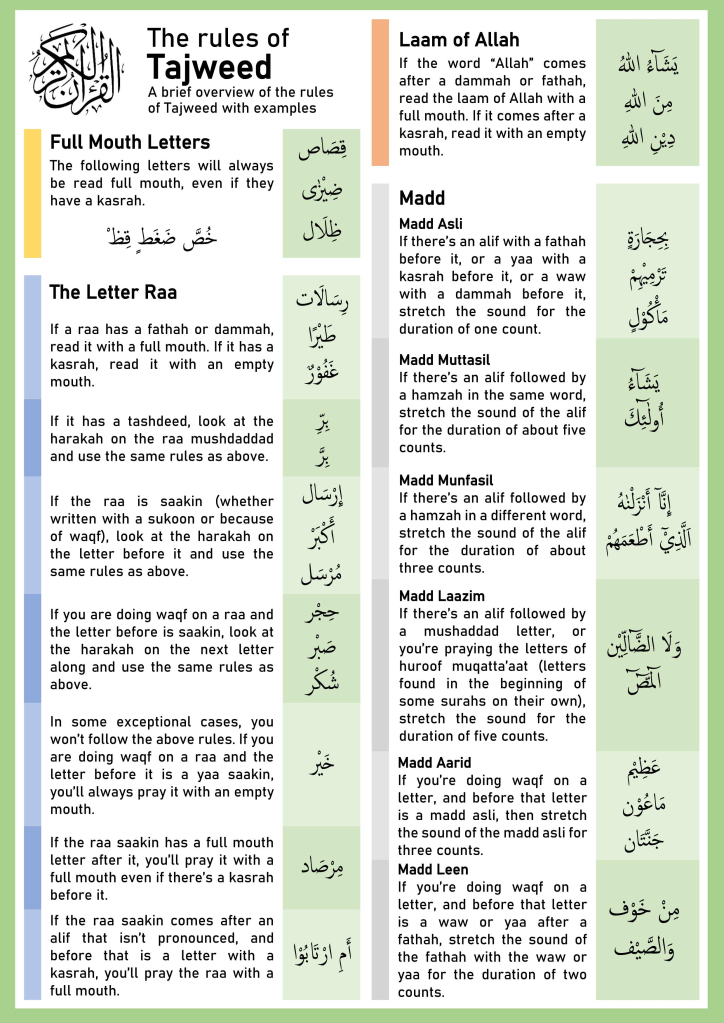
These rules govern how letters interact during recitation, including:
Elongation (Madd): The lengthening of vowel sounds.
Nasalization (Ghunnah): A nasal sound that occurs with certain letters.
Emphasis (Tashdeed): Doubling a letter’s sound when it has a Shaddah.
- Tajweed Symbols
Various symbols are used in written Quranic text to guide reciters on how to apply Tajweed rules:
Madd: Indicates elongation.
Sukun: Indicates no vowel sound follows.
Shaddah: Indicates a letter should be pronounced twice.
Conclusion
In summary, mastering Tajweed is essential for anyone who wishes to recite the Quran accurately and beautifully. It not only enhances one’s recitation but also deepens their understanding and appreciation of this sacred text. Ways to learn: Study Under Qualified Teachers: Learning from experienced instructors helps ensure correct application.
Practice Regularly: Consistent practice reinforces learning and improves fluency.
Utilize Audio Resources: Listening to proficient reciters aids in understanding proper pronunciation and intonation.
Below are some of the Tajweed Rules
Soon new topics Inshaallah (If Allah Wills)………
 SCIENTIFIC AND ISLAMIC RESEARCHES