Before we mention the Historical Miracle from the Quran let us Start with the Timeline of the Decoding of Egyptian Hieroglyphs.
- c. 3200-3000 BCE: The earliest known examples of Egyptian hieroglyphs appear during the Naqada III period, marking the beginning of written communication in ancient Egypt. These early inscriptions were primarily used for administrative purposes and labeling goods in royal tombs.
- c. 2700-2200 BCE: Hieroglyphs evolve into a more complex writing system during the Old Kingdom, with significant use in monumental inscriptions and religious texts.
- 5th Century CE: The ability to read and write hieroglyphs is lost as pagan temples are closed under Roman rule, leading to a decline in the use of this script.
- 9th-10th Century CE: Early attempts at deciphering hieroglyphs are made by scholars such as Dhul-Nun al-Misri and Ibn Wahshiyya, but these efforts are largely unsuccessful due to misconceptions about the nature of hieroglyphic writing.
- 17th Century CE: Athanasius Kircher proposes that hieroglyphs may represent sounds rather than solely ideas, marking a shift in understanding, although his interpretations remain influenced by mystical beliefs.
- 1799 CE: The Rosetta Stone is discovered by French troops during Napoleon’s campaign in Egypt. This artifact contains a decree inscribed in three scripts: Greek, Demotic, and Hieroglyphic.
- Early 19th Century (1800-1820): Scholars such as Silvestre de Sacy and Thomas Young begin studying the Rosetta Stone and make initial progress in understanding Demotic and some phonetic elements of hieroglyphs.
- 1822 CE: Jean-François Champollion successfully deciphers Egyptian hieroglyphs using the Rosetta Stone as a key reference point. He identifies that hieroglyphic writing is a combination of phonetic signs (representing sounds) and ideographic signs (representing ideas). His work establishes much of the grammar and vocabulary of ancient Egyptian.
- 1837 CE: Karl Richard Lepsius refines Champollion’s work by identifying that many hieroglyphs represent combinations of two or three sounds rather than just one, further enhancing the understanding of this ancient script.
- 1850s CE: By this time, scholars have developed a more comprehensive understanding of Egyptian scripts, allowing for full translations of ancient texts to be achieved.
The timeline illustrates how Egyptian hieroglyphs transitioned from their inception around 3200 BCE through centuries of use until their eventual decipherment in the early 19th century by key figures like Champollion.
Example of the Egyptian hieroglyphs
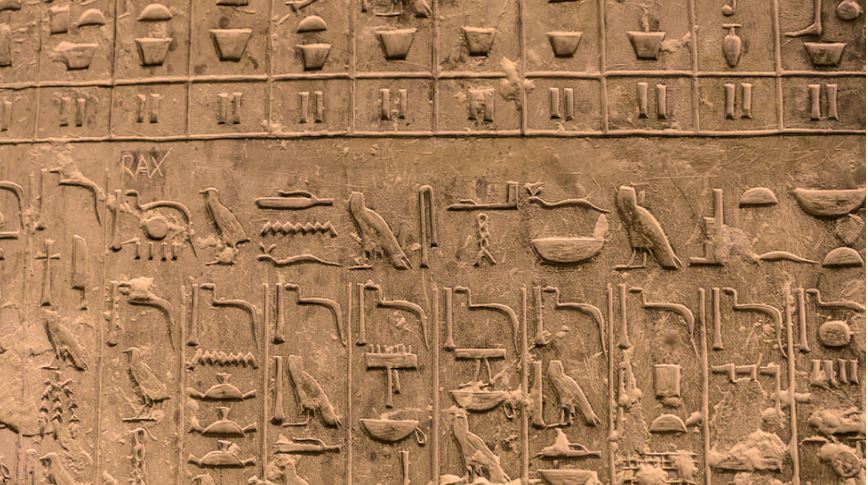
It was discovered during decipherment various Texts and some of these are as below. Text Number 1365c from the below list highlighted below is interested and its the subject of our Research. It says:
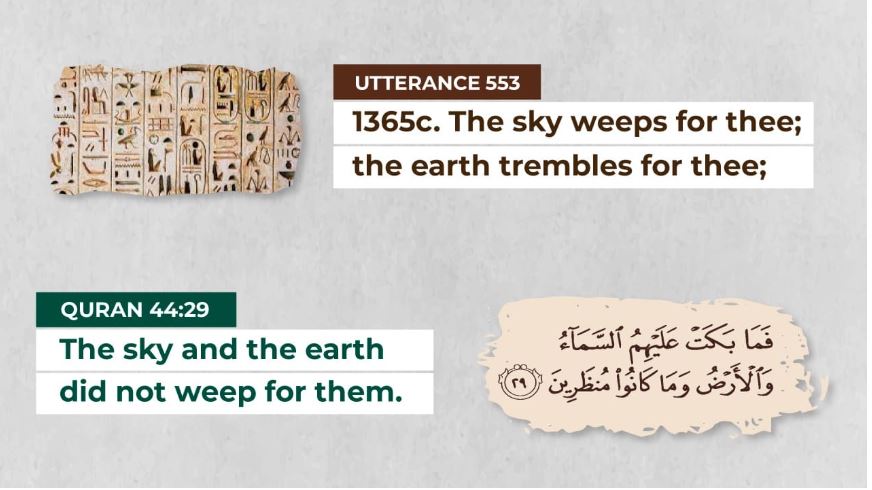
1365c. The sky weeps for thee; the earth trembles for thee.
And this represents a miracle that will leave you speechless. The Quran mentions many tyrannical kings and wrongdoers, but it specifically states about Pharaoh’s destruction that “the sky and the earth did not weep.” Why is this? Here we find a significant miracle that astonishes us. You may wonder what is so miraculous about this. The Discovery of this Phrase was after deciphering of the hieroglyphs in the 19th Century and Even Prophet Mohamad didn’t now anything about this Old Egyptian Language which was not discovered at that time. Prophet Mohamad lived between 6th and 7th Century. And this is a proof that The Prophet is truthful and his message is Authentic because Quran replies to the Pharaohs beliefs from this writing by saying:
فَمَا بَكَتۡ عَلَيۡہِمُ ٱلسَّمَآءُ وَٱلۡأَرۡضُ وَمَا كَانُواْ مُنظَرِينَ (٢٩)
Translation
And the heaven and earth wept not for them, nor were they reprieved.
—————
Contrary to what is mentioned in the Pyramid Texts, the Qur’an makes it clear that the sky and the earth did not weep for this dead pharaoh, i.e. they did not mourn his death. Since the phrase “sky and the earth did not weep” is used in the Quran only when talking about the destruction of the Pharaoh, one cannot call this a coincidence.
Prophet Muhammad who lived 1400 years ago or anyone who lived during his time had absolutely no knowledge of the Pyramid Texts or what was written in them.
How did Prophet Muhammad, who lived 1400 years ago and was an illiterate, know what was written in these pyramid texts which were discovered only in 1881? Who could have taught him this?
Any unbiased thinking person will agree that surely another human being could not have taught this to Prophet Muhammad.
If it is impossible for human beings to say this 1400 years ago, it is rational to believe that God Almighty who knows the past, present and future, must have revealed this to Prophet Muhammad.
Isn’t this miracle sufficient for us to recognize that the Quran is indeed the word of God?
There are several sources which you can get the deciphered hierographic Texts. There ate also Texts at Big Libraries around the world where you can check yourself and you can later compare with the Quran.
30. RESURRECTION, MEAL, AND ASCENSION OF THE DECEASED KING, UTTERANCE 553.
Utterance 553.
1353a. To say: Geb has raised thee up; this thy spirit has been guarded for thee.
1353b. Thy mns-jar remains; thy mns-jar is caused to remain.
1353c. Thou art more exalted than Shu and Tefnut in the house of Ḥtmw.t (the destroyer), N.,
1354a. for thou art verily a spirit who wast nursed by Nephthys with her left breast.
1354b. Osiris has given to thee the spirits; take the eye of Horus to thee.
1355a. These thy four ways which are before the grave of Horus
1355b. are those whereon one goes (lit. goes a going) to the god
as soon as the sun sets (or, as far as the setting of the sun).
1356a. He takes hold of thine arm, after Seker, chief of Pdw-š purified thee,
1356b. (and he conducted thee) to thy throne which is in ḳbḥ.w.
1357a. Raise thyself up, spirit of N.; sit, eat thou;
1357b. let thy ka be seated, that he may eat bread and beer with thee without ceasing for ever and ever.
1358a. Thy going is as a representative of Osiris;
1358b. thy feet hit thine arms;
1358c. they bring thee to thy feasts,
1358d. to thy white teeth, (to) thy fingernails, (to) the Dw.f-nome.
1359a. Thou ferriest over as the great bull to the green fields,
1359b. to the pure places of Rē‘.
1360a. Raise thyself up, spirit of N.; thy water belongs to thee, thine abundance belongs to thee;
1360b. thine efflux belongs to thee, which issued from the secretion of Osiris.
1361a. The double doors of heaven are open for thee; the double doors of ḳbḥ.w are undone for thee;
1361b. the double doors of the tomb are open for thee; the double doors of Nut are unfastened for thee.
1362a. “Greeting,” says Isis; “ferry on in peace,” says Nephthys,
1362b. after she had seen thy father, Osiris, on the day of the mm.t-feast (or, of feasting him who is in need ?).
1362c. Elevated is the ddb.t-chapel of the double ’itr.t-palace of the North, thy Grg.w-bȝ.
1363a. Raise thyself up; shake off thy dust;
1363b. remove the dirt which is on thy face; loose thy bandages.
1363c. They are indeed not bandages; they are the locks of Nephthys.
13 64a. Travel over the southern regions; travel over the northern regions;
1364b. be seated on thy firm throne.
1364c. Anubis, who is chief of the sḥ-ntr, commands that thy spirit be behind thee, that thy might be in thy body,
1364d. that thou remain Chief of the mighty ones (or, spirits).
1365a. Thou purifiest thyself with these thy four nmś.t-jars,
1365b. (with) the špn.t and ‘ȝt-jar, which come from the sḥ-ntr for thee, that thou mayest become divine.
1365c. The sky weeps for thee; the earth trembles for thee;
 SCIENTIFIC AND ISLAMIC RESEARCHES