Scientists have struggled to understand the meeting of the bodies of water and have created various terms over time, while the Quran used a single word for these concepts over 1400 years ago, which effectively encompasses all these scientific definitions. If Allah wills in this Article we will learn what the Scientists have achieved and also learn the Verse from the Quran and we will also use Images to Make it easier to grasp the topic.
First Let’s start by presenting some Scientific Achievements, the images and later we will end with the Quranic Verse.
1-Introduction to the Meeting of Seas and Water Bodies
The phenomenon where two seas or water bodies meet and are separated by a barrier is a fascinating geographical occurrence. This barrier can be due to various factors such as differences in density, salinity, or other physical properties.
2-Scientific Term for the Barrier Between Seas
The scientific term used to describe the barrier between two seas or water bodies is often related to the concept of “halocline” or more broadly, “oceanic or water stratification.” Halocline refers specifically to the layer of water where the salinity changes significantly with depth, creating a barrier between waters of different salinity levels. However, when discussing the meeting of seas, the term “pycnocline” is also relevant, as it refers to the layer where water density changes rapidly with depth, which can be due to changes in salinity, temperature, or both. In brief we can summarise these terms into 4 types:
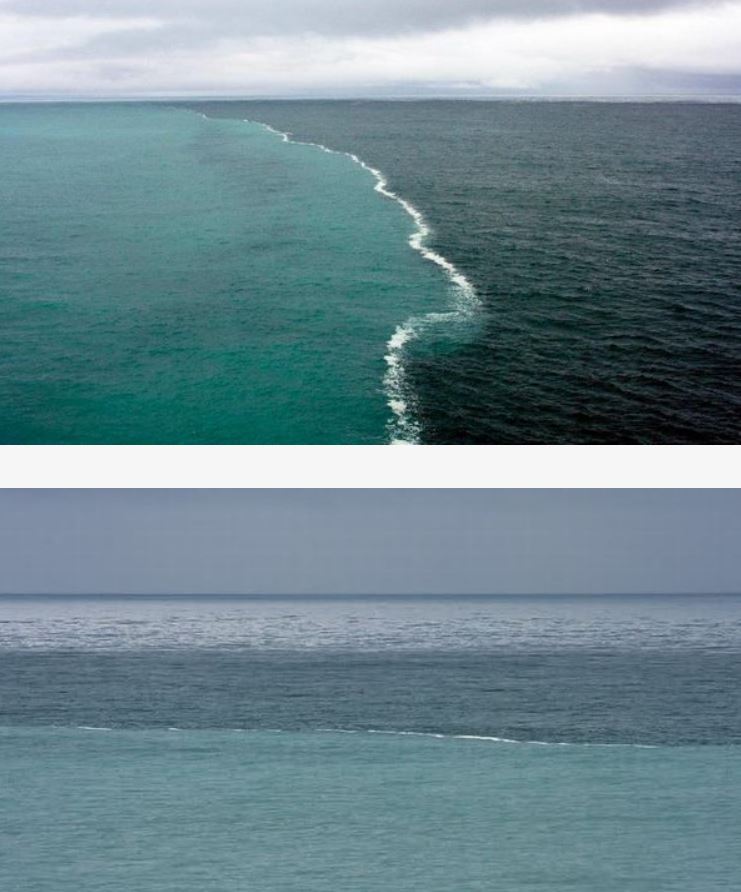
Ocean Fronts: This is a key term. Ocean fronts are defined as “masses of surface water that have different temperatures or salinity.”
These fronts can be very sharp and create visible boundaries.
Thermocline: This term refers to a layer in the ocean where temperature changes rapidly with depth.
Halocline: This term refers to a layer in the ocean where salinity changes rapidly with depth. It’s a specific type of pycnocline.
Pycnocline: This term refers to a layer in the ocean where density changes rapidly with depth, often due to changes in temperature and/or salinity. This is a more general term encompassing both haloclines and thermoclines.
3-Examples of Meeting of Seas
One of the most cited examples is where the Mediterranean Sea meets the Atlantic Ocean at the Strait of Gibraltar. Here, there’s a visible distinction between the two water bodies due to differences in density and salinity, although they do mix. Another example is the meeting of the Red Sea and the Indian Ocean through the Bab-el-Mandeb Strait, where again, differences in salinity and temperature create distinct water layers.
Meeting of Seas and Rivers
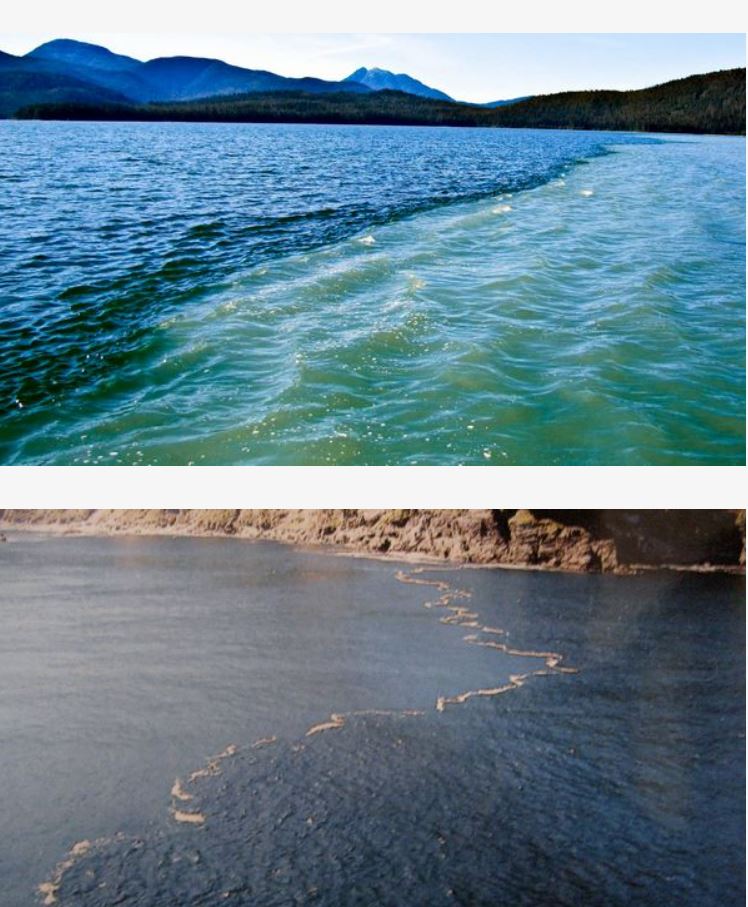
When rivers meet seas, the mixing of freshwater and saltwater creates an “estuary,” which is a partially enclosed coastal body of water, where freshwater from rivers and streams mixes with saltwater from the sea. Examples include the Chesapeake Bay in the United States, where the Susquehanna River meets the Atlantic Ocean, and the Ganges River Delta in India/Bangladesh, where the Ganges River empties into the Bay of Bengal.
4-Area of Transit
The area where two seas or water bodies meet and mix is an important transit zone for various marine species and nutrients. This area can be considered a “mixing zone” or “ecotone,” where the interaction between different water bodies supports a rich biodiversity.
5-Geographical Names and Examples
- Strait of Gibraltar: Mediterranean Sea and Atlantic Ocean.
- Bab-el-Mandeb Strait: Red Sea and Indian Ocean.
- Chesapeake Bay: Susquehanna River and Atlantic Ocean. (Estuaries: Where rivers meet the ocean, a similar phenomenon occurs. The freshwater and saltwater don’t immediately mix, creating a transition zone).
- Ganges River Delta: Ganges River and Bay of Bengal.
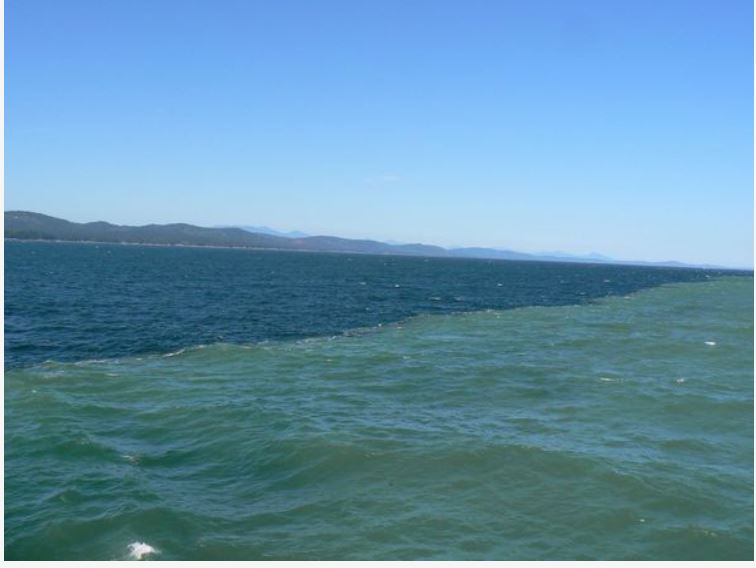
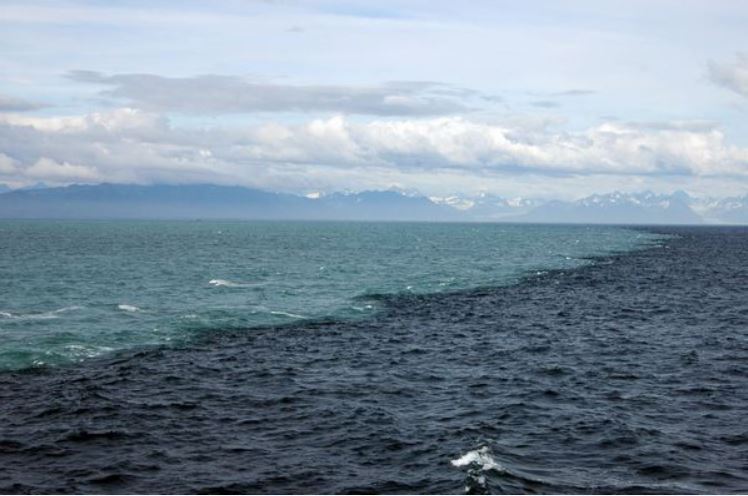
- Gulf of Alaska: The meeting of freshwater from glaciers and rivers with the saltwater of the Pacific Ocean is a prime example. The difference in salinity and density creates a visible boundary.
The phenomenon of seas meeting and being separated by a barrier is a complex and fascinating area of study. Examples around the world, such as the Strait of Gibraltar and the Ganges River Delta, illustrate the diversity of these interactions. The scientific term used to describe the barrier when two seas meet is related to “thermocline”, “pycnocline” and “halocline,” and the area of transit can be considered a “mixing zone” or “ecotone.”
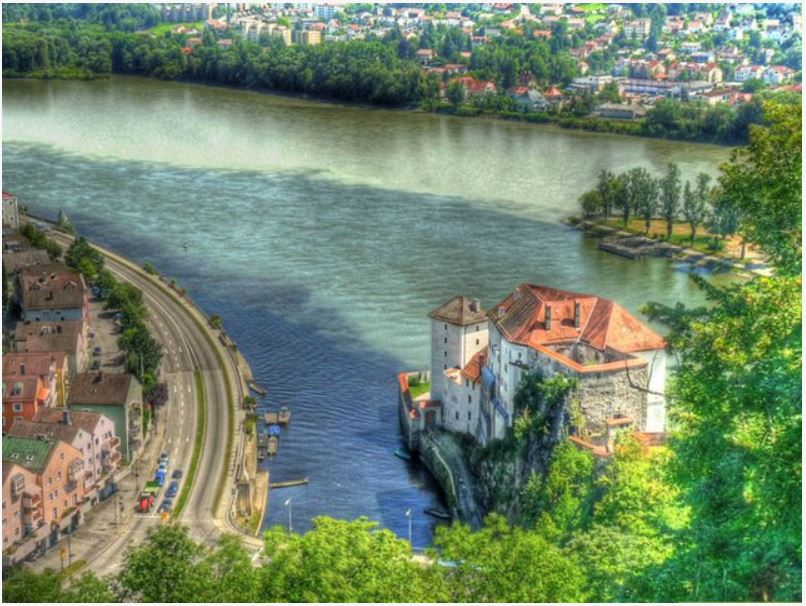
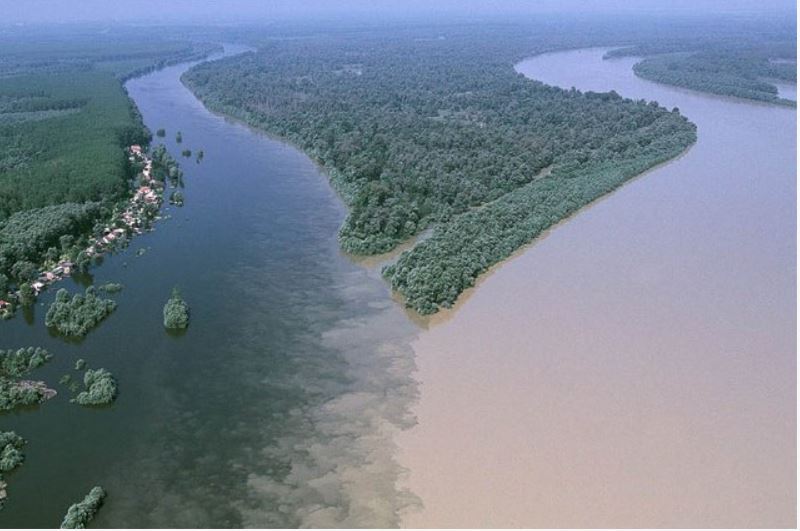
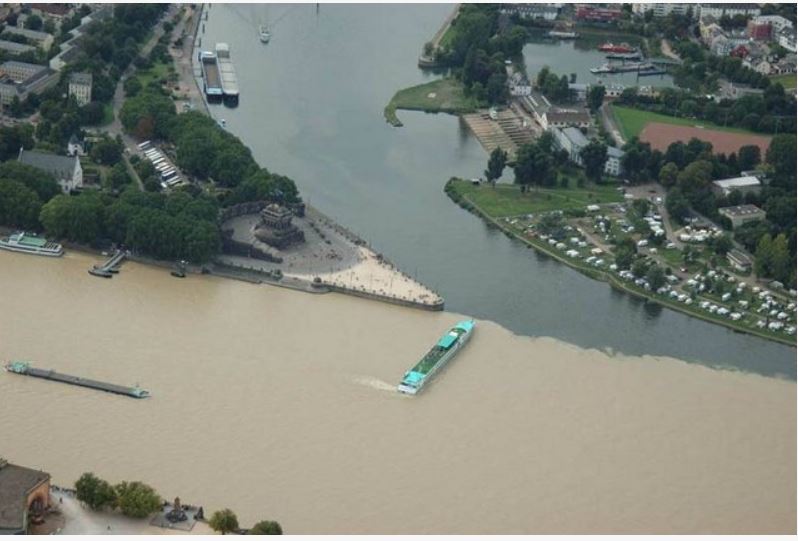
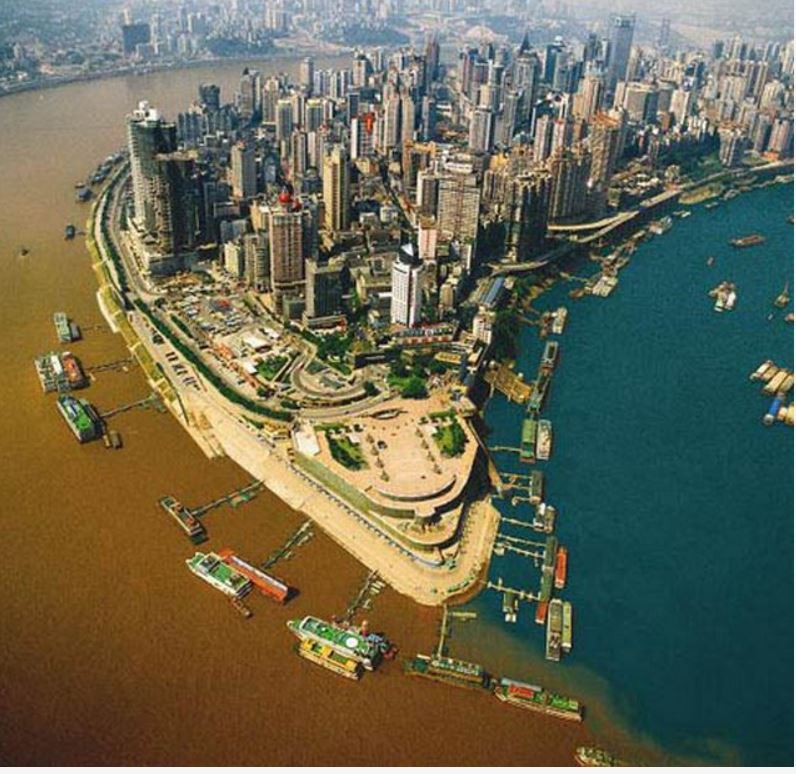
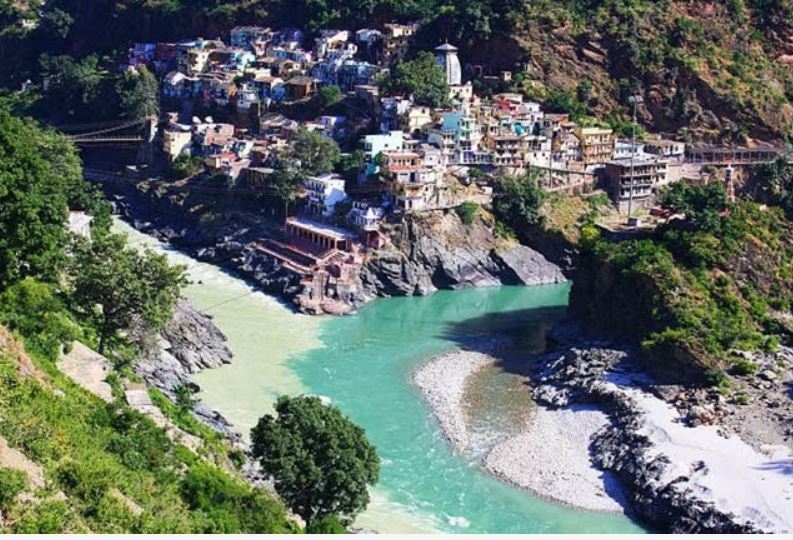
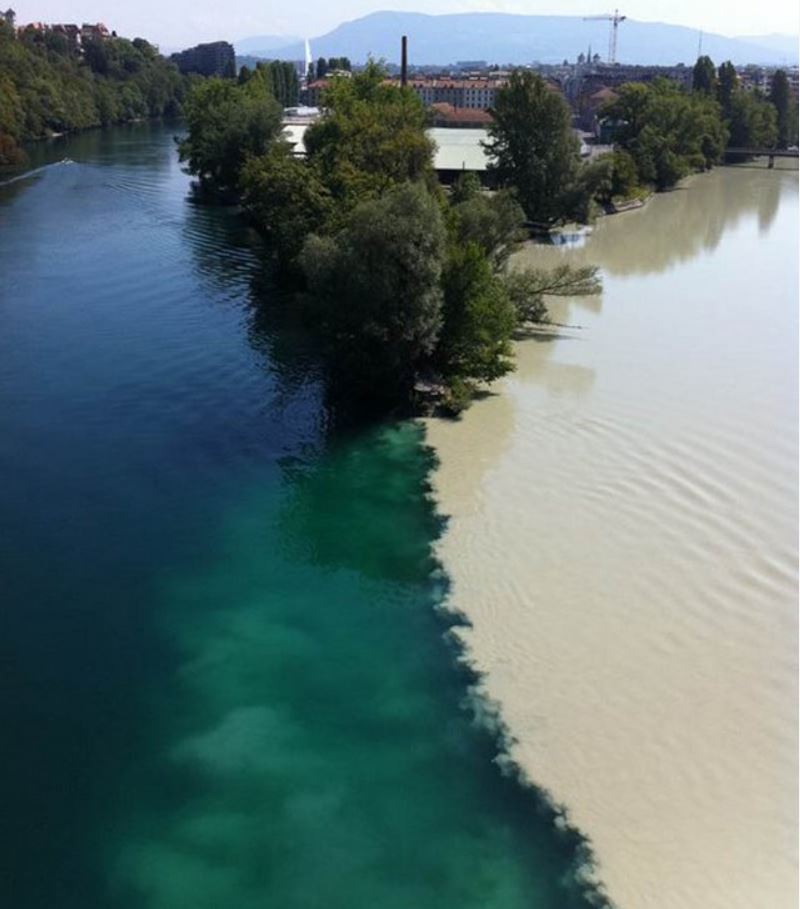
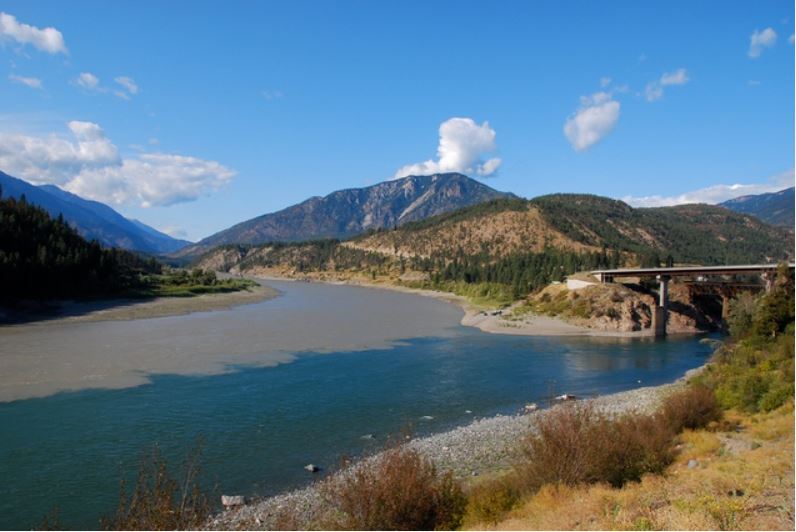
6-Images of the meeting of the Bodies of Water around the world, between Seas, Oceans and Rivers.
7-Video
The Science and these images are from our modern world. With the help of satellites and other scientific instruments have helped us to understand more about this phenomenon.
Now let’s go back to the 7th Century and listen to Prophet Mohamad who was illiterate and during the time when there were no any Satellites or Universities where you can learn all this stuff!!!!!!
Let’s explore these Quranic Verses and see what they say about this phenomenon. This is a major scientific discovery that shows the Quranic words are divine and not human-made.
—————–
8-Verses From The Quran
From Chapter Number 25 Verse Number 53 The Chapter is also known as Surat Al-Furqan
(وَهُوَ الَّذِي مَرَجَ الْبَحْرَيْنِ هَذَا عَذْبٌ فُرَاتٌ وَهَذَا مِلْحٌ أُجَاجٌ وَجَعَلَ بَيْنَهُمَا بَرْزَخًا وَحِجْرًا مَحْجُورًا) [الفرقان: 53]
Translation
And it is He who has released [simultaneously] the two seas, one fresh and sweet and one salty and bitter, and He placed between them a barrier and prohibiting partition.
The word مَرَجَ (MARAJA) has three meanings found in Arabic dictionaries. It means “Mixing and Blending,” “Difference,” and “Disorder.”
————————————————
From Chapter Number 27 Verse Number 61 The Chapter is also known as Surat An-Naml
(أَمَّنْ جَعَلَ الْأَرْضَ قَرَارًا وَجَعَلَ خِلَالَهَا أَنْهَارًا وَجَعَلَ لَهَا رَوَاسِيَ وَجَعَلَ بَيْنَ الْبَحْرَيْنِ حَاجِزًا أَءلَهٌ مَعَ اللَّهِ بَلْ أَكْثَرُهُمْ لَا يَعْلَمُونَ) [النمل: 61].
Translation
Is He [not best] who made the earth a stable ground and placed within it rivers and made for it firmly set mountains and placed between the two seas a barrier? Is there a deity with Allah ? [No], but most of them do not know.
From Chapter 55 Verses 19-20 The Chapter is also known as Surat Al-Rahman.
مَرَجَ ٱلۡبَحۡرَيۡنِ يَلۡتَقِيَانِ (١٩)
بَيۡنَہُمَا بَرۡزَخٌ۬ لَّا يَبۡغِيَانِ (٢٠)
Translation
He has let free the two bodies of flowing water, meeting together:
Between them is a Barrier which they do not transgress
The dynamics of water mixing in estuaries and the open ocean represent some of the most complex interactions in physical oceanography. An estuary is a partially enclosed coastal body of brackish water with one or more rivers or streams flowing into it, and with a free connection to the open sea. In these environments, the interaction between freshwater and saltwater creates a highly energetic “front zone” where density gradients are extreme. Conversely, in the open ocean, such as the Strait of Gibraltar where the Mediterranean Sea meets the Atlantic Ocean, the transition is governed by larger-scale thermohaline circulation, leading to a more stable, albeit still distinct, boundary.
9-The Dynamics of Density: Pycnocline, Halocline, and Thermocline
In physical oceanography, the stratification of water is determined by its density (). The Pycnocline is the layer where the density gradient is greatest within a body of water. This density is a function of two primary variables: salinity () and temperature (). The relationship is often expressed through the equation of state for seawater:where is pressure. In estuaries and upper ocean layers, pressure effects are negligible compared to temperature and salinity.
- The Halocline (Salinity): This is the vertical zone in the water column where salinity changes rapidly with depth. In an estuary, freshwater (salinity psu) floats over denser seawater (salinity psu). This creates a sharp halocline that acts as a barrier to vertical mixing.[1]
- The Thermocline (Temperature): This is the layer where temperature changes rapidly. While salinity usually dominates estuarine density, the thermocline plays a vital role, especially in deeper estuaries or during seasonal shifts where surface heating or river runoff temperature differs significantly from the ocean.
- The Pycnocline (Density): The pycnocline is the “master” layer. It is the result of both the halocline and the thermocline working together. In estuaries, the pycnocline is primarily “halocline-driven,” whereas in the open tropical ocean, it is often “thermocline-driven.”
10-Estuaries vs. Open Ocean Fronts (The Barzakh)
The term Barzakh is often used in a multidisciplinary context to describe a barrier or partition. In oceanography, this corresponds to the “Frontal Zone.”
In an Estuary, the environment is “messy” and high-energy. The constant influx of river water and the ebb and flow of tides create a “Salt Wedge” or a “Highly Stratified” system. The kinetic energy from the river flow and tidal currents causes shear instability at the pycnocline. This leads to internal waves and turbulent mixing, yet the density difference is so strong that the “wall” between fresh and salt water persists.
In the Open Ocean (e.g., the Mediterranean-Atlantic transition), the scale is much larger. The Mediterranean water is saltier and denser due to high evaporation, while the Atlantic water is fresher and cooler. When they meet, the Mediterranean water sinks beneath the Atlantic water. Because there are no narrow geographical constraints like riverbanks, the transition is more gradual and stable. The pycnocline here is deeper and less subject to the “violent” mixing seen in shallow estuaries.
11-Clarification on “Hijrah Mahjurah” and Estuarine Classification
Regarding the classification of an estuary as Hijrah Mahjurah (often interpreted as a “forbidden partition” or “partitioned zone”), this terminology stems from classical linguistic and theological descriptions of the natural world. In a scientific context, an estuary is defined by the Knudsen Relation, which calculates the ratio of freshwater discharge to tidal volume.
12-Summary
| Feature | Estuary (High Energy Zone) | Open Ocean Front (Stable Zone) |
|---|---|---|
| Primary Driver | River Flow & Tidal Flux | Evaporation & Global Currents |
| Halocline | Extremely sharp; shifts with tides | Gradual; deep-seated |
| Thermocline | Variable; depends on seasonal runoff | Stable; dictated by latitude |
| Pycnocline (Density) | Strongest/Messy; driven by | Stable/Calm; driven by and |
| Mixing Mechanism | Turbulent Shear / Entrainment | Double Diffusion / Isopycnal Mixing |
| Classical Term | Hijrah Mashjurah (Partitioned) | Barzakh (Barrier) |
13-The Role of Density in the “Invisible Wall”
Density is the resultant force. It is not a separate “layer” like the halocline, but rather the physical property that the halocline and thermocline create. In fluid mechanics, the Richardson Number () is used to determine if the density “wall” will break:Where is gravity, is the density gradient (Pycnocline), and is the velocity shear. If , the “wall” (the pycnocline) remains stable and resists mixing, even if the water is moving fast.
In an estuary, the density gradient is so high that even with fast-moving water, the “partition” remains intact, effectively separating the two distinct ecosystems. This confirms the scientific basis for a “forbidden partition” where the two waters are prevented from immediate and total homogenization.
14-Biological Implications of the “Prohibiting Partition
The term hijran mahjura (prohibiting partition) does not imply that no life can exist there; rather, it refers to a biological and physical boundary that restricts the movement of species from one environment to another. Most marine organisms are stenohaline, meaning they can only tolerate a narrow range of salinity. If a saltwater fish enters the freshwater side of the partition, its cells would burst due to osmotic pressure; conversely, freshwater fish would dehydrate in saltwater.
However, there is a specific category of life that survives within this “partition” or estuary zone:
- Euryhaline Species: These are organisms capable of adapting to a wide range of salinities. Examples include the Bull Shark (Carcharhinus leucas), which possesses specialized kidneys to handle both environments, and Salmon, which undergo physiological changes to move between the sea and rivers.
- Estuarine Vegetation: Plants such as Mangroves (Rhizophora) and Cordgrass (Spartina) have evolved salt-secreting glands or ultra-filtration systems in their roots to survive in the brackish water of the “partition” zone.
- Invertebrates: Species like the Blue Crab (Callinectes sapidus) and various types of Oysters thrive specifically in the nutrient-rich but volatile environment of the estuary partition.
15-Scientific Perspectives on Estuarine Mixing
In the context of Surah Al-Furqan, the “forbidding partition” is often associated with the dynamics of estuaries. When a river (fresh water) meets the sea (salt water), they do not mix instantly due to differences in density. The density of water () is a function of salinity () and temperature ():Because fresh water is less dense, it often floats above the salt water in a “salt wedge” formation. The interface between these two layers is the halocline. This interface is not just a line but a three-dimensional zone with its own unique characteristics. This zone effectively “prohibits” the salt water from encroaching too far upstream and “prohibits” the fresh water from losing its identity too quickly, thus acting as the hijran mahjura.
16-The Distinction of Hijran Mahjura
The phrase hijran mahjura is derived from the root h-j-r, which implies prohibition, prevention, or making something “taboo” and inaccessible. While barzakh is a general term for a barrier or partition, hijran mahjura implies a “partition that is forbidden to be passed” or an “impenetrable zone.”
The reason this specific term appears in Surah Al-Furqan (25:53) and not in Surah Ar-Rahman (55:19-20) is attributed to the different physical dynamics of the waters being described:
- The Barzakh (General Barrier): In the meeting of two salt seas (as interpreted in Surah Ar-Rahman), there is a surface tension and density difference that prevents immediate mixing, creating a “barrier” where each sea maintains its temperature and salinity for a distance.
- The Hijran Mahjura (The Estuarine Zone): In Surah Al-Furqan, the text describes the meeting of fresh river water and salty sea water. Modern oceanography identifies this as an estuary. In these areas, a “pycnocline” or “halocline” zone exists—a layer where the density changes sharply. This zone acts as a “forbidding partition” because it has a distinct biology and physics that prevents the two types of water from simply merging into a uniform state immediately. It serves as a functional buffer that protects the freshwater ecosystem from the high salinity of the sea.
17-Classical Interpretations of the Barrier
Classical scholars offered various perspectives on the nature of these barriers before the advent of modern oceanography:
- Ibn Abbas and Al-Qurtubi: They viewed the barrier as a “barrier of God’s decree” (barzakh min amr Allah). Even though the waters appear to touch, the divine will prevents the salt water from spoiling the sweetness of the fresh water, which is essential for human and animal life.
- Al-Tabari: He emphasized the linguistic meaning of hijr, noting that it refers to a “forbidden area,” much like the Hijr of the Kaaba or the hijr (intellect) that restrains a person from foolishness.
If Allah wills more topics will follow soon………..
 SCIENTIFIC AND ISLAMIC RESEARCHES