05/01/2026
May Allah bless Brother Anis from Algeria for this important topic. I have diligently learned and researched it again, taking the time to deeply understand the nuances of the subject, then presented it with carefully selected photos in my own way to enhance its clarity and appeal. However, I want to emphasize that the original research and inspiration come from Brother Anis, whose efforts laid the foundation for this discussion. The intention behind this work is to seek Allah’s rewards, and understanding this divine purpose drives us to ensure that the subject is free from any errors. Although mistakes can sometimes occur in the process of sharing knowledge, we always strive to minimize these occurrences through thorough verification and commitment to accuracy. It is our responsibility to uphold the integrity of the information shared, and in doing so, honor the efforts of those who have contributed to this valuable topic.
The mysterious letters (muqaṭṭaʿāt, Arabic: حُرُوف مُقَطَّعَات ḥurūf muqaṭṭaʿāt, “disjoined letters” or “disconnected letters”) are combinations of between one and five Arabic letters that appear at the beginning of 29 out of the 114 chapters (surahs) of the Quran.
The letters are also known as fawātiḥ (فَوَاتِح) or “openers” as they form the opening verse of their respective surahs.
Surat Al-Twaha is named after its first verse, muqaṭṭaʿāt: Ṭā-Hā.
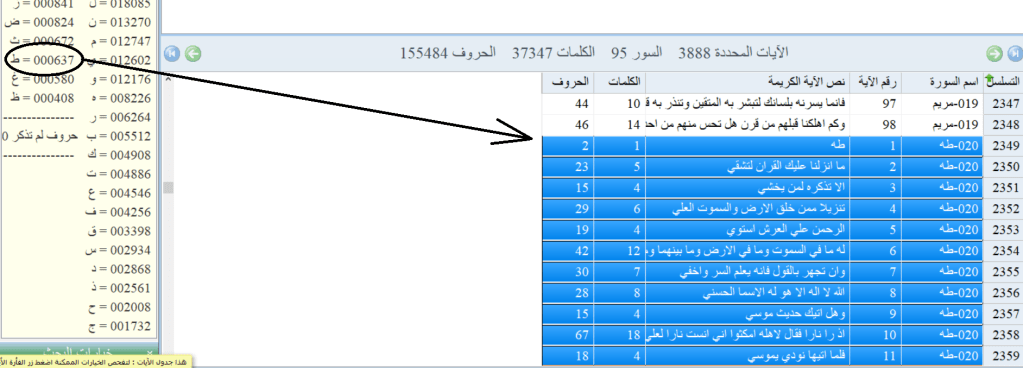
The letter Ṭā ط at the beginning of this chapter is notable because it appears in the middle of all Ṭā ط letters in the Quran, with 636 letters to its left and 636 letters to its right, making it the 637th instance.!!!!!
The Below Photo from the Data Counter Shows 636 Letters TWA counting from the beginning of the Quran to The first Letter TWA of the first Verse TWAHA
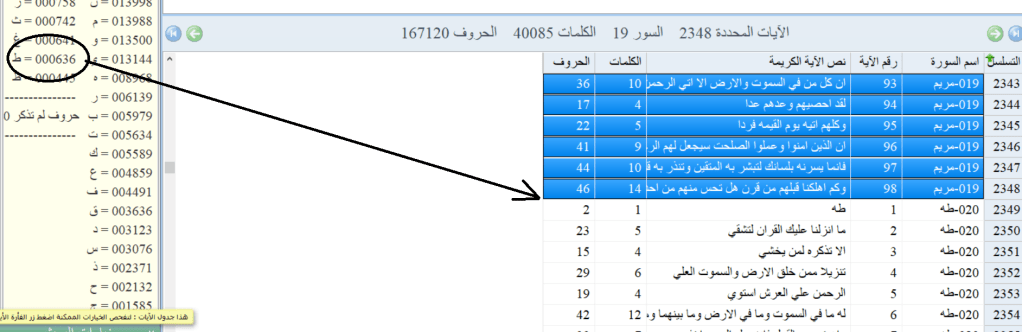
The below Verses from the Data Counter shows 637 letters counting from The first Letter TWA of Verse of the Chapter TWAHA to the end of the Quran.
So The Total of 637 Letters including the Letter TWA of the first Verse of the Chapter 20 TWAHA to the end of the Quran we have exactly 636 Letters TWA!!!!! .
In total, there are 1,273 Ṭā (Transliteration: TWA) letters in the Quran. If we include the Ṭā letters from the chapter titles, there are 7 more, bringing the total to 1,280 letters.
In the entire Quran, only 7 out of 114 chapter Titles use the letter ط in their titles.
1/Chapter Number 20 (Al-Twaha)
2/Chapter Number 35 (Al-Tur)
3/Chapter Number 52 (Al-Tur)
4/Chapter Number 65 (Al-Talaq)
5/Chapter Number 82 (Al-Infitar)
6/Chapter Number 83 (Al-Mutwafifiyn)
7/Chapter Number 86 (Al-Tariq)
From These 7 Chapters Titles the Chapter title Number 20 Al-Twaha takes the first position!!!!
And if we look at the entire Quran, we will find that only 4 chapters begin with the letter ط (Remember, these are chapter names, not titles, so don’t get confused with the Chapter Titles).
1/Chapter Number 20 (Al-Twaha) Starts with TWA-HA
2/Chapter Number 26 (Al-Shuaraa) Starts with TWA_SIN_MIYM
3/Chapter Number 27 (Al-Naml) Starts with TWA_SIN
4/Chapter Number 28 ( Al-Qasas) Starts with TWA_SIN_MIM
and From These 4 Chapters the Chapter Number 20 Al-Twaha also takes the first position!!!!
This Arrangement is astonishing and shows that Quran is not from humans and not from this world. No one can arrange and count letters is a big book like the Quran even today in the age of Computer is still not easy and remember that this arrangement was in the 7th Century!!!!!!!! and remember that not only arrangement but there are underlying meanings only few whom Allah choses and wishes understands them.
Let u snow use Arithmetic and see the results
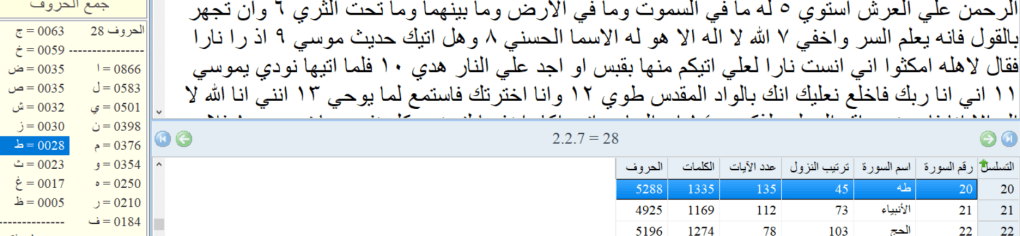
Let’s multiply 7 chapters by 4: 7 x 4 = 28.
Number 28 corresponds to the Number of the letters TWA in the Chapter 20 (Al-Twaha) which has 28 Letters TWA. as in the Photo Below!!!!
All parts of the text, including chapters, verses, letters, and diacritical marks, are counted and preserved meticulously to maintain the authenticity and integrity of the Quran. Is it possible for a human to do this, especially in the 7th Century before the advent of digits and advanced technology? The remarkable precision achieved in this preservation process is nothing short of miraculous. Allahu Akbar (God is Great).
Now I understand why the Quran is preserved so thoroughly and why no human could, or will ever be able to, add, remove, or change anything within its verses. The meticulous care taken in its compilation and transmission through generations leads to an unbroken chain of authenticity. Its structure and its content reflect an extraordinary level of protection and reverence. It exemplifies a complete and very high level of digital security, albeit created centuries before the digital age emerged, displaying an impressive foresight that transcends time and technology. The commitment of its followers to preserving its original message highlights a profound respect for its divine origin and significance.
(I would also mention that even the diacritical marks (although added later and not part of revelation) to simplify recitation were also under the protection of Allah as we have done researches and found mathematical miracles from these too. The Scholars added in the Quran a comprehensive system of diacritical marks, collectively known as Tashkīl (forming) or Ḥarakāt (motions), to indicate precise pronunciation and ensure accurate recitation. These marks are essential for non-native Arabic speakers, as standard Arabic script generally omits them in everyday writing.
The primary marks used for pronunciation in the Quran include:
Vowel Marks (Ḥarakāt)
These marks indicate short vowels and are the most fundamental diacritics:
Fatḥah (ـَ): A small diagonal line above a letter, indicating a short “a” sound.
Kasrah (ـِ): A small diagonal line below a letter, indicating a short “i” sound.
Ḍammah (ـُ): A small curl-like mark above a letter, indicating a short “u” or “o” sound.
Other Essential Marks
In addition to short vowels, other marks guide proper recitation (known as Tajweed rules):
Sukūn (ـْ): A small circle or head of the Arabic letter ḥāʾ (ح) above a consonant, indicating the absence of a vowel (a silent letter).
Shaddah (ـّ): A small “w”-shaped mark above a letter, indicating that the consonant should be doubled or geminated.
Tanwīn (ـً ـٍ ـٌ): Doubled vowel marks (e.g., two fatḥahs) at the end of a word, which add an “n” sound to the vowel (e.g., an, in, un).
Maddah (ـٓ): A tilde-shaped diacritic placed over an ʾalif (آ) to indicate a prolonged “a” sound (a glottal stop followed by a long a).
Dagger Alif (ـٰ): A short vertical stroke above a letter, indicating a long “a” sound where a full alif is not written.
Alif Waṣlah (ٱ): A mark resembling a small ṣād above an alif, indicating that the alif should not be pronounced if the word is connected in continuous recitation (when it does not begin a sentence).
These marks were developed by early Islamic scholars to preserve the precise pronunciation of the Quran’s original recitation as Islam spread to non-Arabic-speaking regions)
Let’s continue with this research…..
Before Chapter 20, AL-TWAHA, there are 19 Chapters, and after it, 95 Chapters. It’s unusual that the letter TWA appears in such a strange distribution. The first 19 Chapters contain 636 letters, while the remaining 636 letters are spread across the 95 Chapters following Chapter 20. Its a plan and not at Random. We also learned that Number 19 is mentioned in the Quran Chapter Al-Mudathir and we have shown in this website the miraculous nature of this Number and here too is used in a strange way. Remember That The first Verse of the Quran بِسۡمِ ٱللَّهِ ٱلرَّحۡمَـٰنِ ٱلرَّحِيمِ is composed of 19 letters.
Prophet Mohamad would not have any time to write a book and count each letter, word, and verse, as the task itself requires an immense amount of dedication and focus. It’s impossible to achieve, even with today’s advanced computers and technology at our disposal. Remember, it’s not only about counting but also about weaving together profound meanings, intricate details, and an entire landscape of scientific knowledge, blended together in a very high level. The complexity of such a work transcends mere numbers; it involves a deep understanding of language, context, and the spiritual essence that each word conveys, making it a monumental challenge that goes far beyond the arithmetic of writing.
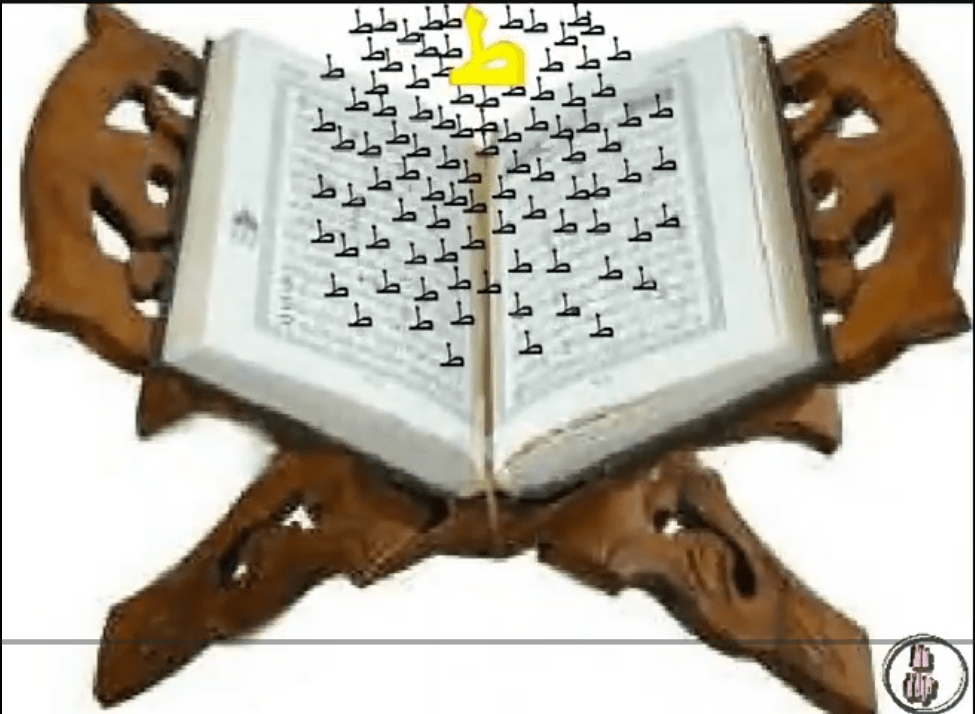
The Letter TWA in the middle and surrounded by the exact number of TWA letters.
Allah, the Creator, knows best
According to the Brother Anis’s research, this is a historical miracle and a prophecy. So the Story begins with the life of Omar Ibn Al-Khataab. The History can be verified from Books and Internet using Google etc.
Omar Ibn Al-Khattab’s conversion to Islam is a pivotal event in early Islamic history, occurring around the sixth year of Prophet Muhammad’s prophethood, which would be approximately 616 CE.
His conversion is often attributed to a powerful encounter with the Quran. Before his conversion, Omar was a staunch opponent of Islam and had even set out to kill Prophet Muhammad.
The traditional account states that on his way to confront the Prophet, he was informed that his sister, Fatima bint al-Khattab, and her husband, Saeed ibn Zayd, had embraced Islam.
Enraged, he went to their house, where he found them reciting the Quran. He struck his sister, causing her to bleed, but her steadfastness and the beauty of the verses they were reading deeply affected him.
The Surah they were reciting was Surah Taha. Specifically, they were reading from Ayat 1 to Ayat 14.
The first letter from the Quran that Omar is reported to have pronounced is the letter طٰ (TWA) from the opening letters of Surah Taha, “Ta-Ha” (طٰهٰ).
After this profound experience, Omar went to Prophet Muhammad and declared his faith.
There are authentic narrations where the Prophet prayed to Allah, saying,
“O Allah! Strengthen Islam with either of the two Omars, Omar ibn al-Khattab or Amr ibn Hisham (Abu Jahl).”
Allah answered his prayer by guiding Omar ibn al-Khattab to Islam, while Amr ibn Hisham remained an ardent enemy of Islam until his death.
After becoming a Muslim, Omar Ibn Al-Khattab became a strong advocate and protector of the nascent Muslim community. He served as a close companion and advisor to Prophet Muhammad. He became the second Caliph (Amir al-Mu’minin, or Commander of the Faithful) in 634 CE, which was two years after the death of Prophet Muhammad.
This means there were approximately 18 years between his conversion to Islam and his ascension to the Caliphate.
The siege of Jerusalem by the Muslim army began in November 636 CE. The city formally surrendered to Caliph Umar ibn al-Khattab in 637 CE. (sources varying on the exact year of siege and surrender).
On my opinion the year of siege will be exact 636 CE and Surrender will be 637 CE as I believe on the Miracle of the Letter TWA which we have just verified.
While Umar ibn al-Khattab did not lead the military siege, he was present to accept the peaceful surrender of the city as requested by the Christian Patriarch Sophronius.
Umar allowed Jews to return and live peacefully in Jerusalem. The Jewish community had been largely banned from the city by the Romans and Byzantines for nearly 500 years.
The “Covenant of Umar” granted protection and religious liberty to inhabitants (including Christians and Jews).
Umar reportedly ordered the clearing of the Temple Mount and allowed some Jewish families to resettle in the city.
So we can see the Prophecy. The first letter that Omar Ibn Al-Khataab pronounced is TWA, and he recited the Chapter 20 AL-Taha up to Verse 14 before he immediately pronounced the Shahada and embraced Islam.
The First Letter he pronounced for the first time is the 637th and it is surrounded by Exact number of 636 X 2 TWA letters in the Quran. Few Years later he became a Leader and sieged Jerusalem in the year 636 and conquered the year after 637!!!!!!!!
(The 637th Middle Golden TWA letter Surrounded by 636 TWA Letters on its left and 636 Letters on its right / Jerusalem Sieged by the Omar’s Army in the year 636 CE and was given the Keys to Jerusalem in the year 637 CE is one of the Historical Miracles from the Quran which we discover and learn today!!!)
The first letter TWA in the Quran is the 637th letter, with 636 TWA letters on each side.
Omar’s Army laid siege to Jerusalem in 636 CE. and was given the keys to the city in 637 CE.
Perhaps this is the prophecy and Allah knows best.
There may be other information related to the letter TWA that we still don’t know. The Quran is the Book for the rest of this world, and there are many things yet to be discovered in the coming centuries that we are unaware of. Allah knows best.
To be continued soon, InshaAllah.
 SCIENTIFIC AND ISLAMIC RESEARCHES