Section 1
25/02/2026
سُوۡرَةُ طٰه Chapter 20 Verse 114
فَتَعَـٰلَى ٱللَّهُ ٱلۡمَلِكُ ٱلۡحَقُّۗ وَلَا تَعۡجَلۡ بِٱلۡقُرۡءَانِ مِن قَبۡلِ أَن يُقۡضَىٰٓ إِلَيۡكَ وَحۡيُهُ ۥۖ وَقُل رَّبِّ زِدۡنِى عِلۡمً۬ا (١١٤)
Translation
So high [above all] is Allah , the Sovereign, the Truth. And, [O Muhammad], do not hasten with [recitation of] the Qur’an before its revelation is completed to you, and say, “My Lord, increase me in knowledge.”
Exegesis and Context of Surah Ta-Ha, Verse 114
Surah Ta-Ha, the 20th chapter of the Qur’an, was revealed during the middle Meccan period, a time of significant trial for the Prophet Muhammad and the early Muslim community. Verse 114 of this Surah serves as a profound theological statement regarding the nature of God, a practical instruction on the methodology of receiving divine revelation, and a timeless supplication for the pursuit of knowledge. The verse begins by exalting Allah as the “True King,” transitions into a command for the Prophet to remain patient during the process of revelation, and concludes with the famous prayer: “My Lord, increase me in knowledge.”
The Sovereignty of the True King
The opening of the verse, “So high [above all] is Allah, the Sovereign, the Truth,” establishes the absolute authority of the Creator. In classical Arabic linguistics, the term al-Malik (The King) signifies the one who possesses the power of command and prohibition over all of creation. By coupling al-Malik with al-Haqq (The Truth), the Qur’an distinguishes Allah’s dominion from the fleeting and often unjust rule of earthly monarchs. According to the Tafsir Ibn Kathir, this phrasing emphasizes that Allah is “High above and Exalted from what the idolaters describe Him with of deficiencies.” His kingship is not merely a title but a reality that encompasses the truth of the Hereafter, the Day of Judgment, and the divine laws governing existence.
The Prohibition of Haste in Revelation
The middle portion of the verse—”And do not hasten with [recitation of] the Qur’an before its revelation is completed to you”—addresses a specific historical circumstance involving the Prophet Muhammad. During the early years of his mission, the Prophet was deeply concerned about forgetting the words of the revelation as they were being delivered by the Angel Gabriel (Jibril). Consequently, he would attempt to repeat the words immediately, moving his tongue rapidly to memorize the verses while the Angel was still speaking.
This verse, along with similar instructions found in Surah Al-Qiyamah (75:16-19), سُوۡرَةُ القِیَامَة
لَا تُحَرِّكۡ بِهِۦ لِسَانَكَ لِتَعۡجَلَ بِهِۦۤ (١٦) إِنَّ عَلَيۡنَا جَمۡعَهُ ۥ وَقُرۡءَانَهُ ۥ (١٧) فَإِذَا قَرَأۡنَـٰهُ فَٱتَّبِعۡ قُرۡءَانَهُ ۥ (١٨) ثُمَّ إِنَّ عَلَيۡنَا بَيَانَهُ ۥ (١٩)
16/Move not your tongue with it, [O Muhammad], to hasten with recitation of the Qur’an. 17/Indeed, upon Us is its collection [in your heart] and [to make possible] its recitation. 18/So when We have recited it [through Gabriel], then follow its recitation. 19/ Then upon Us is its clarification [to you].
was revealed to reassure the Prophet. Allah commanded him to listen attentively and promised that the preservation of the Qur’an in his heart was a divine responsibility. As noted in the Tafheem-ul-Quran, this instruction was necessary to ensure the Prophet could fully grasp the meanings and nuances of the message without the distraction of trying to memorize it simultaneously. It established a protocol for revelation: first, silent and attentive listening; second, the completion of the message by the Angel; and third, the Prophet’s subsequent recitation.
The Supplication for Increased Knowledge
The final segment of the verse, “and say, ‘My Lord, increase me in knowledge’” (Rabbi zidni ‘ilma), is one of the most significant commands in the Qur’an regarding education and intellectual growth. Scholars of Islamic jurisprudence and theology note that this is the only instance in the Qur’an where Allah commands the Prophet to seek an increase in anything specific. This highlights the preeminent value of knowledge (‘ilm) in the Islamic worldview.
The “knowledge” referred to here is multifaceted. It refers to the understanding of the Qur’an and also encompasses all forms of beneficial knowledge that lead to a better understanding of the Creator and the improvement of the human condition. The Prophet Muhammad continued to use this supplication throughout his life, signifying that the pursuit of knowledge is a lifelong journey that does not end with a specific degree or age.
Reasons for Revelation (Asbab al-Nuzul)
The primary reason for the revelation of this specific verse was the Prophet’s intense eagerness to preserve the Word of God. The Asbab al-Nuzul (Occasions of Revelation) by Al-Wahidi explains that the Prophet’s haste was born out of love for the revelation and a fear of losing any part of it. By intervening with this verse, Allah provided a psychological and spiritual “ease” for the Prophet, shifting the burden of preservation from the human messenger to the Divine Author This allowed the Prophet to focus on the meaning and application of the verses rather than just the phonetic retention of the words.
Linguistic and Grammatical Significance
From a grammatical perspective, the verb ta’jal (to hasten) is used in the jussive mood (majzum) due to the prohibitive la (do not). This indicates a firm command. The use of the word yuqda (completed/finished) suggests that the revelation is a structured process with a definitive beginning and end for each segment. The prayer “My Lord, increase me in knowledge” uses the imperative qul (say), making the act of seeking knowledge a mandatory part of the believer’s spiritual practice.
Counting Miracle
فَتَعَـٰلَى ٱللَّهُ ٱلۡمَلِكُ ٱلۡحَقُّۗ وَلَا تَعۡجَلۡ بِٱلۡقُرۡءَانِ مِن قَبۡلِ أَن يُقۡضَىٰٓ إِلَيۡكَ وَحۡيُهُ ۥۖ وَقُل رَّبِّ زِدۡنِى عِلۡمً۬ا (١١٤)
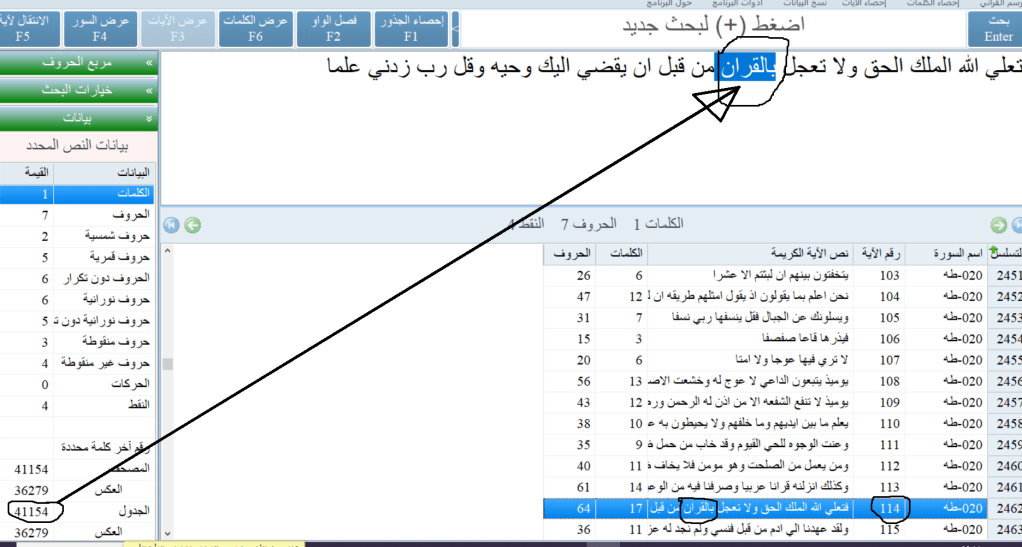
The word بِٱلۡقُرۡءَانِ (Quran) is the 41154th word in the Quran, which has miraculous significance.
41154=19 x 19 x 114
If we count from the beginning of the Quran we will start by reciting the first Verse of Chapter one which is بِسۡمِ ٱللَّهِ ٱلرَّحۡمَـٰنِ ٱلرَّحِيمِ and this Verse is composed of 19 letters.
The Verse فَتَعَـٰلَى ٱللَّهُ ٱلۡمَلِكُ ٱلۡحَقُّۗ وَلَا تَعۡجَلۡ بِٱلۡقُرۡءَانِ مِن قَبۡلِ أَن يُقۡضَىٰٓ إِلَيۡكَ وَحۡيُهُ ۥۖ وَقُل رَّبِّ زِدۡنِى عِلۡمً۬ا (١١٤) is from Chapter 20, which follows 19 Chapters. or simply put, it comes after 19 chapters.
and the Verse itself is the 114th from the beginning of this Chapter.
This is strange!!! 19 Letters x 19 Chapters x 114 Verse Number=41154!!!
Remember that the word QURAN from this Verse is the 41154th if we count all the words from the beginning of the Quran until the word QURAN.
Do you see this Divine Planning? Find below the Proof of the Position of this word from the beginning of the Quran to this word QURAN.
And it’s a miracle that this verse is from Chapter 20, “TWAHA”, which is classed as the 45th chapter revealed to the Prophet. This verse, numbered 114, (Allah knows best) hints to the 114 chapters of the Quran and that there will be more segments (Verses/Chapters) to be revealed later.
The Prophet didn’t know that this Verse is the 114th as the numbering of the Verses and Chapters was introduced later to aid in reciting the Quran, but during the revelation, the Quran Verses and Chapters were not numbered.
Inshallah (If Allah wishes) more miracles soon……..
 SCIENTIFIC AND ISLAMIC RESEARCHES