بِسۡمِ ٱللَّهِ ٱلرَّحۡمَـٰنِ ٱلرَّحِيمِ
20/03/2026
The Development of Islamic Law: From Fiqh to Maqasid (A Simple Historical Guide)
Islamic law did not appear all at once. It developed step by step over centuries, through the work of great scholars. This article explains that journey in a simple and chronological way, including the key figures and their contributions.
1. The Beginning: The Prophet ﷺ (571–632 CE)
Islamic law begins with the Prophet Muhammad ﷺ.
- The Qur’an was revealed.
- The Sunnah explained how to live.
At this stage, there were no schools of law—people followed direct guidance.
2. The Companions (632–700 CE)
After the Prophet ﷺ, his companions spread across the Muslim world.
Important early scholars included:
- Abdullah ibn Abbas (619–687)
- Aisha bint Abi Bakr (613–678)
- Abdullah ibn Masud (d. 653)
They:
- Answered new questions
- Applied Qur’an and Sunnah to real life
This was the first stage of applying Islamic law.
3. The Four Great Imams (700–850 CE)
Islamic law became more organized with the famous Imams:
- Abu Hanifa (699–767)
- Malik ibn Anas (711–795)
- Muhammad ibn Idris al-Shafi’i (767–820)
- Ahmad ibn Hanbal (780–855)
They:
- Studied Qur’an and Hadith
- Developed methods of reasoning
- Built structured schools of law (Fiqh)
They organized and systematized Islamic law.
4. The Development of Legal Theory (800–1100 CE)
Scholars began studying how laws are derived. This field is called Usul al-Fiqh.
One key figure:
- Muhammad ibn Idris al-Shafi’i (767–820)
- Wrote Al-Risala
Later scholars continued developing legal thinking, including:
- Al-Jassas (d. 981)
- Al-Quduri (972–1037)
5. The Five Legal Categories (900–1100 CE)
As Fiqh grew, scholars needed a simple system to classify actions.
They developed the Five Legal Categories:
- Obligatory (Fard/Wajib)
- Recommended (Mustahabb)
- Permissible (Mubah)
- Disliked (Makruh)
- Forbidden (Haram)
This helped Muslims understand what to do in daily life.
6. The Early Idea of Maqasid (1000–1100 CE)
Scholars began asking:
Why do these laws exist?
The concept of Maqasid (the goals of Islamic law) evolved from early hints in the works of Al-Juwayni and his student Abu Hamid al-Ghazali (1058–1111 CE). Al-Ghazali categorized the “necessities” (Daruriyyat) into five: protection of religion, life, intellect, lineage, and property.
A key scholar:
- Abu Hamid al-Ghazali (1058–1111)
In his book:
- Al-Mustasfa
He explained that Islamic law protects five essentials:
- Religion
- Life
- Intellect
- Family (lineage)
- Property
He introduced the core idea of Maqasid.
7. The Full Theory of Maqasid (1300s CE)
The idea was later fully developed by:
The “Full Theory” was indeed reached in the 1300s by the Andalusian scholar Abu Ishaq al-Shatibi (1320–1388 CE). His work, Al-Muwafaqat, is considered the definitive text on Maqasid.
In his famous book:
- Al-Muwafaqat
He explained:
- Islamic law is a complete system with goals
- All rulings aim to protect human welfare
He built the full theory of Maqasid al-Sharia.
8. Modern Revival of Maqasid (1800s–Today)
In modern times, scholars revived Maqasid to deal with new challenges.
In the modern era, the revival was led by Muhammad al-Tahir ibn Ashur (1879–1973 CE), who sought to use Maqasid to reform Islamic social thought. Contemporary scholars like Yusuf al-Qaradawi (1926–2022) and Jasser Auda (b. 1966) have further expanded this into a systems-based approach to modern ethics and governance
They applied Maqasid to:
- modern finance
- medicine
- technology
- global issues
They connected classical law with modern life.
9. How Everything Fits Together
Now we can understand the full system:
The Four Imams
→ Built the rules of Islamic law
Later Scholars
→ Created the Five Legal Categories (what to do)
Al-Ghazali & Al-Shatibi
→ Explained Maqasid (why we do it)
Modern Scholars
→ Apply both to today’s world
10. Simple Example
Protecting Life (a Maqasid):
- Saving a life → Obligatory
- Helping health → Recommended
- Eating food → Permissible
- Risky behavior → Disliked
- Murder → Forbidden
One goal (life), many rulings (categories)
Summary
The development of Islamic law followed a clear path:
- Prophet ﷺ → revealed the law
- Companions → applied it
- Imams → organized it
- Scholars → classified actions
- Al-Ghazali → identified the goals
- Al-Shatibi → developed the full theory
- Modern scholars → apply it today
Islamic law is both:
- A system of rules (Fiqh)
- A system of goals (Maqasid)
Together, they guide human life with both structure and purpose.
This historical journey shows that Islamic law is not static—it is a living system, built over centuries to guide people in every time and place.
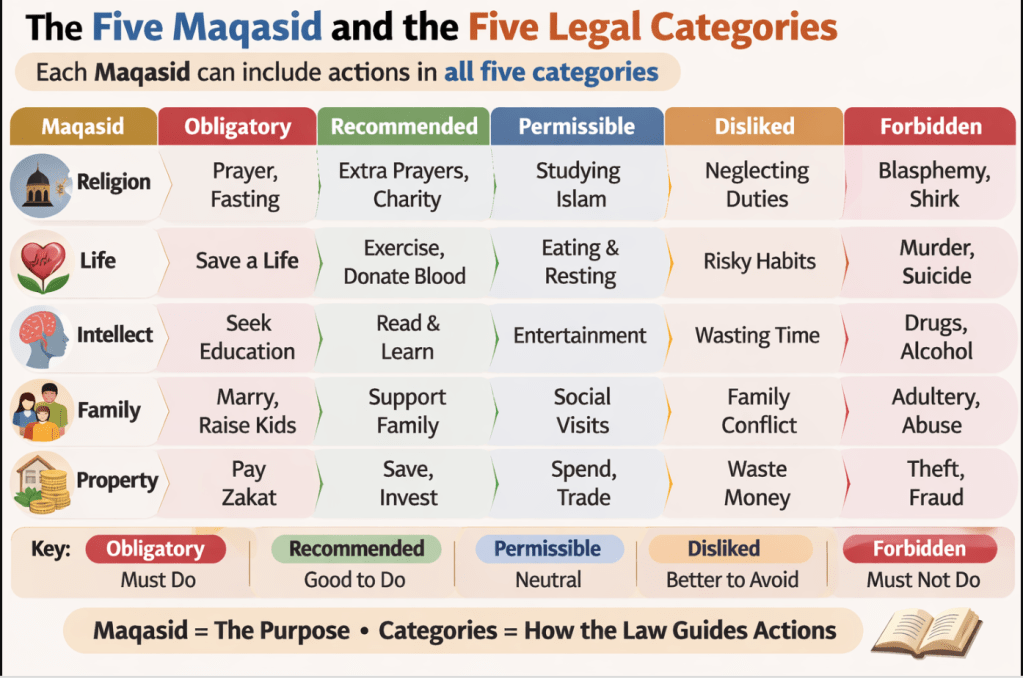
How scholars solve modern issues (simple method)
For any new issue, scholars ask:
What is the issue?
Which Maqasid are involved?
What is the harm or benefit?
Which legal category fits best?
1. Modern Finance
Example 1: Interest-based banking
Step 1: The issue
Modern banks give loans with interest (riba).
Step 2: Maqasid involved
- Property (wealth)
- Justice and fairness
Step 3: Analysis
Interest can:
- Exploit poor people
- Create inequality
Step 4: Legal categories
- Charging interest → Forbidden (Haram)
- Fair trade → Permissible / Recommended
- Helping someone without interest → Recommended or even Obligatory
Solution:
- Create Islamic banking (no interest, profit-sharing)
Example 2: Investing in companies
- If company sells harmful products → Forbidden
- If business is ethical → Permissible / Recommended
Maqasid: Protect wealth + society
2. Medicine
Example: Organ transplant
Step 1: Issue
Transferring organs from one person to another.
Step 2: Maqasid
- Life (very important)
Step 3: Analysis
- Saves lives → strong benefit
- Must avoid harm or exploitation
Step 4: Legal category
- Saving life → Obligatory (in some cases)
- Organ donation → Permissible / Recommended
Result:
Most scholars allow organ transplants with conditions.
Example 2: Vaccination
- Protects life → Recommended or Obligatory
- Prevents harm → aligns with Maqasid
Maqasid: Protection of life
3. Technology
Example 1: Social media
Step 1: Issue
Use of platforms like social media.
Step 2: Maqasid
- Intellect (mind)
- Religion (morality)
- Social well-being
Step 3: Analysis
Same tool → different rulings depending on use:
- Spreading knowledge → Recommended
- Normal use → Permissible
- Wasting time → Disliked
- Spreading lies or harm → Forbidden
Key idea:
Technology itself is neutral—usage determines the ruling.
Example 2: Artificial Intelligence (AI)
- Helping medicine or education → Recommended
- Harmful use (fraud, manipulation) → Forbidden
Maqasid: Protect intellect, society, and justice
4. Global Issues
Example 1: Environmental protection
Step 1: Issue
Pollution, climate change
Step 2: Maqasid
- Life
- Property
- Future generations (family/lineage)
Step 3: Analysis
- Harm to environment = harm to people
Step 4: Categories
- Protect environment → Recommended / Obligatory
- Causing major pollution → Forbidden
Example 2: Human rights & justice
- Oppression → Forbidden
- Justice → Obligatory
Maqasid: protect life, dignity, and society
The Big Pattern
One issue can have all five categories depending on the situation
Example (Technology):
- Learning online → Recommended
- Watching neutral content → Permissible
- Addiction → Disliked
- Harmful content → Forbidden
Simple Understanding
- Maqasid = the goal (WHY)
- Categories = the ruling (WHAT TO DO)
Together they allow scholars to:
Stay faithful to Islam
Solve modern problems
Adapt without changing core principles
Real-Life Summary
Finance → protects wealth
Medicine → protects life
Technology → affects intellect & society
Global issues → protect all five Maqasid
Scholars use both rules + goals to guide decisions.
These are also three other levels of priority in Maqasid, They were explained clearly and systematized by:
- Abu Ishaq al-Shatibi
(though earlier scholars like Abu Hamid al-Ghazali also hinted at them).
1-The Three Levels
Necessities (Daruriyyat)
Absolutely essential
If these are lost:
- Life breaks down or is destroyed
Examples:
- Food
- Safety
- Religion
- Basic health
Needs (Hajiyyat)
Remove difficulty
If missing:
- Life continues, but becomes hard and stressful
Examples:
- Transportation
- Marriage systems
- Jobs and trade
Embellishments (Tahsiniyyat)
Comfort and refinement
If missing:
- Life is still fine, but less الجميل (nice/beautiful)
Examples:
- Luxury items
- Good manners
- Aesthetics
2. Where do these fit in the system?
- Maqasid (5 goals) → what we protect
- Categories (5 rulings) → what to do
And
- 3 Levels (priority) → how important it is
The full system
What? → Legal category (Obligatory, etc.)
Why? → Maqasid (Life, Religion, etc.)
How important? → Level (Necessity, Need, Embellishment)
Application Examples
Now I’ll show you clearly using real cases 👇
Example 1: Medicine (Organ Transplant)
Maqasid:
→ Protect Life
Level:
→ Necessity (Daruriyyat)
Because:
- Without it → person may die
Category:
→ Obligatory / Permissible
Example 2: Finance (Basic income / work)
Maqasid:
→ Protect Property
Level:
→ Need (Hajiyyat)
Because:
- Without income → life becomes very difficult (but not immediate death)
Category:
→ Work → Obligatory or Recommended
Example 3: Technology (Internet)
Maqasid:
→ Intellect / communication
Level:
→ Usually Need (Hajiyyat) today
Because:
- Life is very difficult without it (education, work)
Category:
- Education use → Recommended
- Harmful use → Forbidden
Example 4: Environment
Maqasid:
→ Life + future generations
Level:
→ Can be Necessity (Daruriyyat)
Because:
- Severe damage → threatens survival
Category:
→ Protect environment → Obligatory
Example 5: Luxury Goods
Maqasid:
→ Comfort / lifestyle
Level:
→ Embellishment (Tahsiniyyat)
Because:
- Not necessary at all
Category:
→ Usually Permissible
4. Why this is important
This level system helps scholars decide:
Which rule is stronger than another
Example:
- Saving a life (Necessity) is MORE important than
- Protecting wealth (Need or Embellishment)
So:
In emergencies, some rules can change.
Example:
- Eating normally forbidden food to survive → Allowed
(because necessity overrides)
5. Simple way to remember everything
Think of it like this:
Step 1 — What is being protected?
→ Maqasid (Life, Religion, etc.)
Step 2 — How important is it?
→ Levels (Necessity, Need, Embellishment)
Step 3 — What is the ruling?
→ Categories (Obligatory, etc.)
Final Sentence
- Maqasid = WHAT we protect
- Levels = HOW IMPORTANT it is
- Categories = WHAT we must do
Final insight
This is why Islamic law is so flexible:
It is not just rules
It is a prioritized system
That allows scholars to:
- handle emergencies
- solve modern problems
- balance between harms and benefits
1. What are “Maxims” in Islamic law?
Maxims are called:
Al-Qawa’id al-Fiqhiyyah
They are:
Short general rules that help scholars make decisions quickly
Think of them like:
“Guiding principles”
“Legal shortcuts”
“Summary rules”
2. Are Maxims the same as Maqasid?
| Concept | Meaning | Simple Idea |
|---|---|---|
| Maqasid | Goals of the law | WHY the law exists |
| Maxims | General rules | HOW to think and decide |
3. Simple analogy
Think of Islamic law like a system:
- Maqasid → the destination (goal)
- Maxims → the road signs
- Fiqh rules → the actual instructions
4. Examples of Famous Legal Maxims
Here are some Maxims:
“Actions are judged by intentions”
- If intention is good → reward
- If intention is bad → sin
“Harm must be removed”
- Anything harmful should be stopped
Example:
- Pollution → not allowed
- Dangerous product → removed
“Necessity makes the forbidden permissible”
Example:
- Eating forbidden food to survive → allowed
You already saw this in the medicine example
“Hardship brings ease”
Example:
- Traveler can shorten prayers
- Sick person can break fasting
“Certainty is not removed by doubt”
Example:
- If you are sure you made wudu → doubt doesn’t cancel it
Where do Maxims fit in the system?
Now connect everything:
THREE layers:
Maqasid (Goals)
- Protect life, religion, intellect, etc.
Levels (Priority)
- Necessity, Need, Embellishment
Maxims (Thinking tools)
- “Remove harm”
- “Necessity allows exceptions”
Categories (Final rulings)
- Obligatory, Forbidden, etc.
Application
Case: Life-saving medicine (forbidden substance)
- Maqasid → Life
- Level → Necessity
- Maxim → “Necessity makes the forbidden permissible”
- Category → Permissible / Obligatory
7. Example (Technology)
Case: harmful social media content
- Maqasid → Protect intellect
- Maxim → “Harm must be removed”
- Category → Forbidden
8. Simple Understanding
Maqasid = WHY (the goal)
Maxims = HOW TO THINK (decision tools)
Categories = WHAT TO DO (final ruling)
One sentence to remember
Maqasid give the purpose, maxims give the method, and fiqh gives the ruling.
Complete Table: Maqasid + Levels + Maxims + Categories
| Issue / Case | Maqasid (Goal) | Level (Priority) | Maxim Used | Final Ruling (Category) | Explanation |
|---|---|---|---|---|---|
| Life-saving medicine (forbidden substance) | Life | Necessity | Necessity makes forbidden permissible | Permissible / Obligatory | Saving life overrides prohibition |
| Organ transplant | Life | Necessity | Harm must be removed | Permissible / Recommended | Removes harm and saves life |
| Vaccination | Life | Necessity / Need | Harm must be removed | Recommended / Obligatory | Prevents disease |
| Basic work / income | Property | Need | Hardship brings ease | Obligatory / Recommended | Eases difficulty in life |
| Interest loan (luxury) | Property | Embellishment | Harm must be removed | Forbidden | No necessity, causes harm |
| Interest loan (emergency) | Life / Property | Necessity | Necessity makes forbidden permissible | Sometimes Permissible | Emergency changes ruling |
| Ethical investment | Property | Need | Harm must be removed | Permissible / Recommended | Supports fairness |
| Social media (learning) | Intellect | Need | Actions judged by intentions | Recommended | Good intention and benefit |
| Social media (normal use) | Intellect | Embellishment | Permissibility is default | Permissible | Neutral use |
| Social media (waste of time) | Intellect | Embellishment | Harm should be minimized | Disliked | Low benefit |
| Social media (harmful content) | Intellect | Harmful | Harm must be removed | Forbidden | Damages individuals/society |
| AI (education/medicine) | Intellect / Life | Need | Harm must be removed | Recommended | Brings benefit |
| AI (fraud/manipulation) | Property / Intellect | Harmful | Harm must be removed | Forbidden | Causes injustice |
| Environmental protection | Life / Property | Necessity | Harm must be removed | Obligatory | Protects survival |
| Pollution | Life | Necessity threat | Harm must be removed | Forbidden | Causes serious damage |
| Luxury goods | Property | Embellishment | Permissibility is default | Permissible | Not necessary |
| Marriage | Family | Need | Hardship brings ease | Recommended / Obligatory | Protects family system |
| Adultery | Family | Necessity | Harm must be removed | Forbidden | Protects lineage |
How to Read This Table
Every row follows the same thinking process:
Step 1: What are we protecting?
Look at Maqasid
- Life
- Property
- Intellect
- Family
Step 2: How serious is it?
Look at Level
- Necessity → life or system will break
- Need → removes hardship
- Embellishment → comfort only
Step 3: Which principle helps decide?
Look at Maxim
This is the thinking tool, for example:
- “Harm must be removed”
- “Necessity makes forbidden permissible”
- “Actions depend on intention”
Step 4: What is the final ruling?
Look at Category
- Obligatory
- Recommended
- Permissible
- Disliked
- Forbidden
One Row Explained (Example)
Life-saving medicine:
- Maqasid → Life
- Level → Necessity
- Maxim → Necessity allows exceptions
- Result → Permissible / Obligatory
- Because:
- Saving life is more important than avoiding the forbidden substance.
Big Picture
This table shows the complete system working together:
Maqasid → WHY (goal)
Level → HOW IMPORTANT
Maxim → HOW TO THINK
Category → WHAT TO DO
Final Sentence
Islamic law is not just rules—it is a system of goals, priorities, and principles that lead to wise decisions.
Inshaallah (If Allah Wills) More Topics soon …
 SCIENTIFIC AND ISLAMIC RESEARCHES