1-Reflections on the Universe and Divine Harmony
بِسۡمِ ٱللَّهِ ٱلرَّحۡمَـٰنِ ٱلرَّحِيمِ
04/04/2026
The main point of this article is based on another researcher’s ideas. It’s not a miracle, but rather a unique concept that comes from harmony in numbers.
Where no specific attribution is provided, the content represents my own research; otherwise, it is duly credited to its original source. May Allah bless and reward his efforts.
This reflection remains open to critique and scholarly discussion. However, I found it sufficiently meaningful to examine it further and to present it here following my own independent review.
When encountering research of potential value, I make every effort to study it carefully and critically. Once satisfied with its merit, I restate it in clear and accessible language, occasionally incorporating illustrative examples to enhance understanding.
Allah knows best, as all knowledge is ultimately with Him, and we remain learners at every stage. Any errors or shortcomings in the presentation of this material are solely my responsibility.
I sincerely ask Allah to accept this humble effort and to overlook any mistakes, judging it according to my intentions.
Planck Measurements and the Harmony of Creation: A Reflection
At the deepest level of the physical universe, science introduces us to extraordinary quantities known as Planck units. These represent the smallest meaningful scales at which both quantum effects (the physics of very small particles) and gravitational effects (the physics of massive objects) come together.
The smallest possible length is known as the Planck length:
ℓₚ = 1.616255 × 10⁻³³ cm
From this fundamental unit, we can derive:
- The Planck area (a tiny square of space):
Aₚ = ℓₚ² = 2.6121 × 10⁻⁶⁶ cm² - The Planck volume (a tiny cube of space):
Vₚ = ℓₚ³ = 4.2217 × 10⁻⁹⁹ cm³
These values are unimaginably small—far beyond anything we can directly observe. They arise naturally from the fundamental constants of physics and mark a boundary where our current understanding of the universe reaches its limits.
A Remarkable Numerical Pattern
An interesting pattern appears in the powers of these values:
- Planck length → 10⁻³³
- Planck area → 10⁻⁶⁶
- Planck volume → 10⁻⁹⁹
This progression follows a simple mathematical rule:
- Squaring multiplies the exponent (33 × 2 = 66)
- Cubing multiplies it again (33 × 3 = 99)
From a scientific perspective, this is a natural result of mathematical operations. However, beyond mathematics, such patterns can also invite deeper reflection.
Dhikr and the Number 99
In Islamic practice, believers engage in dhikr (remembrance of Allah) by repeating:
- “Allahu Akbar” 33 times
- “SubhanAllah” 33 times
- “Alhamdulillah” 33 times
This totals 99 recitations, traditionally associated with the 99 names of Allah.
The appearance of the sequence 33, 66, and 99 in the structure of Planck measurements may be viewed—not as scientific proof—but as a meaningful point of reflection. It can remind us of rhythm, repetition, and harmony within both the physical universe and spiritual practice.
The Qur’an and Universal Glorification
The Qur’an teaches that glorification of Allah is not limited to human beings, but is a universal reality shared by all creation:
Surah Al-Isra (17:44):
تُسَبِّحُ لَهُ ٱلسَّمَـٰوَٲتُ ٱلسَّبۡعُ وَٱلۡأَرۡضُ وَمَن فِيہِنَّۚ وَإِن مِّن شَىۡءٍ إِلَّا يُسَبِّحُ بِحَمۡدِهِۦ وَلَـٰكِن لَّا تَفۡقَهُونَ تَسۡبِيحَهُمۡۗ إِنَّهُ ۥ كَانَ حَلِيمًا غَفُورً۬ا (٤٤)
The seven heavens and the earth and whatever is in them exalt Him. And there is not a thing except that it exalts [Allah] by His praise, but you do not understand their [way of] exalting. Indeed, He is ever Forbearing and Forgiving.
Surah An-Nur (24:41):
أَلَمۡ تَرَ أَنَّ ٱللَّهَ يُسَبِّحُ لَهُ ۥ مَن فِى ٱلسَّمَـٰوَٲتِ وَٱلۡأَرۡضِ وَٱلطَّيۡرُ صَـٰٓفَّـٰتٍ۬ۖ كُلٌّ۬ قَدۡ عَلِمَ صَلَاتَهُ ۥ وَتَسۡبِيحَهُ ۥۗ وَٱللَّهُ عَلِيمُۢ بِمَا يَفۡعَلُونَ (٤١)
Do you not see that Allah is exalted by whomever is within the heavens and the earth and [by] the birds with wings spread [in flight]? Each [of them] has known his [means of] prayer and exalting [Him], and Allah is Knowing of what they do.
Surah Al-Hashr (59:1):
سَبَّحَ لِلَّهِ مَا فِى ٱلسَّمَـٰوَٲتِ وَمَا فِى ٱلۡأَرۡضِۖ وَهُوَ ٱلۡعَزِيزُ ٱلۡحَكِيمُ (١)
Whatever is in the heavens and whatever is on the earth exalts Allah , and He is the Exalted in Might, the Wise.
Surah Al-Jumu’ah (62:1):
يُسَبِّحُ لِلَّهِ مَا فِى ٱلسَّمَـٰوَٲتِ وَمَا فِى ٱلۡأَرۡضِ ٱلۡمَلِكِ ٱلۡقُدُّوسِ ٱلۡعَزِيزِ ٱلۡحَكِيمِ (١)
Whatever is in the heavens and whatever is on the earth is exalting Allah , the Sovereign, the Pure, the Exalted in Might, the Wise.
These verses suggest that every part of creation—living and non-living—exists in a state of remembrance, each in its own way.
A Reflection on Unity and Harmony
From this perspective, one may contemplate that even the smallest scales of existence—the Planck length, area, and volume—are part of a deeply ordered system.
While science explains these measurements through mathematical laws, a believer may experience them as a reminder of unity and harmony in creation. The repetition of numerical patterns and the structured nature of the universe can inspire reflection on a world in which everything operates with balance and purpose.
This does not serve as scientific proof of a spiritual connection. Rather, it can be understood as a personal and meaningful reflection—one that deepens appreciation of both the physical universe and acts of worship.
Conclusion
The study of the universe reveals extraordinary precision and structure at even the smallest scales. At the same time, faith teaches that all creation participates in glorifying its Creator.
Bringing these perspectives together allows for a richer understanding—where science explains how the universe operates, and reflection gives it deeper meaning.
In this way, the patterns we observe in nature may inspire us to think of a universe filled with harmony, where everything—seen and unseen—exists in a state of remembrance.
2-The study of cryptography
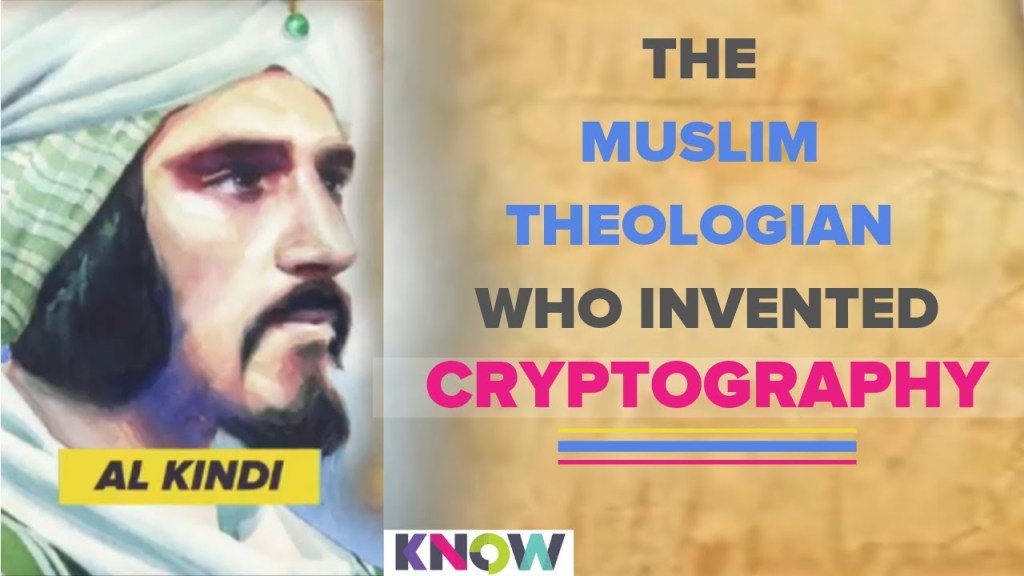
The Father of Code-Breaking: Al-Kindi and the Secret of Language
The brilliant polymath Abū Yūsuf Yaʻqūb ibn Isḥāq al-Kindī (often called “the philosopher of the Arabs”) is widely credited by historians of science and cryptography as the first person to formally describe the method of frequency analysis. While he did not use the modern term “substitution,” his work laid the foundation for breaking monoalphabetic substitution ciphers, which were the primary way people hid secret messages in his time
Long before computers and secret agents, he figured out how to read “invisible” messages? and he lived over 1,000 years ago in a place called Baghdad. Many historians call him the “Father of Cryptology” because he was the first person to write down a scientific way to break secret codes.
Long before computers existed, people needed to send secret messages. Imagine you are a king and you want to send a letter to your general, but you are afraid an enemy might steal it. If you just write the message normally, the enemy will read it. So, you use a “secret code.” For a long time, people thought their codes were impossible to break. Then, a brilliant thinker named Al-Kindi came along and changed everything.
Before Al-Kindi, people thought that if you used a substitution cipher (where you swap one letter for another), the message was impossible to read unless you had the secret key. Al-Kindi proved that language has a fingerprint. Because every language uses certain letters more often than others, the “fingerprint” of the language is always hidden inside the encrypted message, no matter how much you scramble the letters.
He essentially turned cryptography from a guessing game into a mathematical science. By using the frequency of letters, pairs, and even common word endings, he could systematically peel back the layers of a cipher until the original meaning was revealed
What is Cryptology?
Imagine you and your best friend have a secret language. You decide that every time you write the letter “A,” you will actually write the letter “Z.”
If someone else finds your note, they will be very confused! This is called encryption.
Cryptology is the study of how to make these secret codes (encryption) and how to break them (decryption).
Al-Kindi’s Big Discovery: Frequency Analysis
Before Al-Kindi, people thought the only way to break a code was to guess the secret key. But Al-Kindi noticed something amazing about the way we talk and write. He realized that in every language, some letters show up much more often than others.
Think about the English language. If you look at a whole book, the letter “E” appears way more often than the letter “Z.”
Al-Kindi realized that if you have a secret message, you can count how many times each “secret” symbol appears.
If one symbol appears the most, it is probably the letter “E”! This technique is called Frequency Analysis.
How did he break the codes? (The “Frequency Analysis” Trick)
Example 1
Imagine you receive this secret note: “XOO”
- You know that in your language, the letter “O” is the most common letter.
- You see that “O” appears twice in your secret note.
- You guess that “O” stands for “E.”
- Now your note looks like: “XEE”
- You guess that “X” might be “T” or “S.” You try “T” and get “TEE.” That’s a word! You just broke the code!
Al-Kindi wrote a book called A Manuscript on Deciphering Cryptographic Messages where he explained this step-by-step. He showed that you don’t need magic to break a code; you just need to be a good detective and look for patterns.
Imagine you write a secret note to a friend. You replace every ‘A’ with a ‘Z’, every ‘B’ with an ‘X’, and so on. This is called a Substitution Cipher. You thought it was safe because there are billions of ways to scramble the alphabet.
But Al-Kindi discovered that every language has a “rhythm.” In English, the letter ‘E’ is used more than any other letter. In other languages, it might be ‘C’ or ‘A’. Al-Kindi realized that even if you scramble the letters, the frequency (how often a letter appears) stays the same.
The “Cat” Example: if ‘C’ is the most common letter in your language, does that mean ‘C’ is the code for ‘E’? Yes! If you see a secret note and the letter ‘Q’ appears 50 times, you look at your language’s frequency chart. If ‘E’ is the most common letter in your language, you guess that ‘Q’ actually stands for ‘E’. If you see a three-letter word like “Q-Z-T” and you know ‘Q’ is ‘E’, you might guess the word is “E-A-T.” You just cracked the code without the key! This technique is called Frequency Analysis
Example 2
To understand Al-Kindi’s genius, let’s play a game. Imagine you have a secret message where every letter ‘A’ is replaced by a ‘Z’, every ‘B’ is replaced by an ‘X’, and so on. This is called a “substitution cipher.”
Before Al-Kindi, people thought these codes were unbreakable because there were so many ways to scramble the letters. But Al-Kindi realized something simple: Languages have patterns.
Think about the English language. If you look at a whole book, the letter ‘E’ shows up way more often than the letter ‘Z’. If you see a secret message and the letter ‘Q’ appears 20 times, but the letter ‘J’ only appears once, you can guess that ‘Q’ is probably ‘E’! This is called Frequency Analysis.
Al-Kindi wrote a book called A Manuscript on Deciphering Cryptographic Messages. In it, he explained that if you count how often each symbol appears in a secret message, you can match those counts to the most common letters in your language. It was like solving a giant puzzle by looking at the pieces that fit the most often.
Example 3-Modern Computers
How do modern computers use this today? You might wonder: “If Al-Kindi’s trick is so old, do computers still use it?”
Actually, modern computers use a much more advanced version of his idea. When you type your password into a website, the computer doesn’t save your password as “Password123.” If a hacker stole the company’s list of passwords, they would see your real password! Instead, the computer uses a “Hash Function.”
Think of a Hash Function like a mathematical blender. You put your password in, and the blender turns it into a long, scrambled string of numbers and letters. It is impossible to turn the “smoothie” back into the original fruit. When you log in, the computer blends your password again and checks if the result matches the one it has saved.
Al-Kindi taught us that patterns are the key to secrets. Today, computers use incredibly complex math to make sure those patterns are so hidden that even the fastest supercomputer in the world couldn’t guess your password in a billion years! We are essentially using Al-Kindi’s logic—analyzing patterns and frequencies—to build “digital locks” that are much stronger than the ones he broke.
Example 4
Create Your Own Secret Code: The Substitution Cipher
You can try this right now! A “Substitution Cipher” is when you swap every letter for a different one.
- Write the alphabet: A B C D E F G H I J K L M N O P Q R S T U V W X Y Z
- Write a “scrambled” alphabet underneath: Q W E R T Y U I O P A S D F G H J K L Z X C V B N M
- Translate: If you want to write “CAT,” look at the top row and find the letter, then use the letter directly below it. “C” becomes “E,” “A” becomes “Q,” and “T” becomes “Z.” Your secret code is “EQZ.”
To break it, a friend would count which letters appear most often in your note and guess that the most common one is “E.
How Computers Use Al-Kindi’s Ideas Today
You might think, “If Al-Kindi’s trick is so easy, why are my passwords safe?” Great question! Modern computers use Al-Kindi’s idea—patterns—but they make them so complicated that even a supercomputer would take billions of years to count them.
Computers use something called Hashing. Think of a “blender.” If you put a strawberry, a banana, and milk into a blender, you get a smoothie. You can’t turn the smoothie back into a strawberry! Computers take your password (the fruit) and “blend” it into a long string of random numbers and letters (the smoothie).
When you type your password, the computer blends it again. If the “smoothie” matches the one it has saved, it lets you in. Because the computer uses math that is way too hard to reverse-engineer, even if a hacker sees your “smoothie,” they can’t figure out your password. They can’t use Al-Kindi’s frequency trick because the computer makes the patterns look completely random!
Why was he so important?
Al-Kindi was like the world’s first “hacker,” but he used his powers for science and math. He proved that language has a “fingerprint.”
Even if you scramble the letters, the frequency (how often they appear) stays the same. This discovery changed the world forever. Every time you send a text message or buy something online today, your information is protected by complex codes—but those codes are only safe because we learned from the rules Al-Kindi discovered centuries ago.
Who was Al-Kindi?
Al-Kindi was a famous scholar who lived over 1,000 years ago in Baghdad. He was like a “super-scientist”—he studied math, music, medicine, and philosophy. He is often called the “Father of Cryptanalysis” (which is just a fancy word for “code-breaking”). He didn’t just invent a code; he invented the method to solve any code that used a simple substitution system
The Two-Step Process
Al-Kindi’s method effectively combined two concepts that we now separate:
- Frequency Analysis (The Counting): He instructed the codebreaker to take the encrypted text and count the frequency of every single symbol. He knew that the “frequency distribution” of the letters in the secret message would match the “frequency distribution” of the language itself.
- Substitution (The Mapping): Once he knew which symbol represented the most common letter, he could “substitute” it back into the text. By repeating this for the second-most common letter, the third-most, and so on, the entire message would eventually reveal itself. He essentially turned a guessing game into a mathematical process.
Why This Was Revolutionary
Before Al-Kindi wrote his famous book, A Manuscript on Deciphering Cryptographic Messages, people thought that if you swapped letters around, a message was safe forever. Al-Kindi proved that no simple substitution cipher is truly secure if the message is long enough to provide a good sample for counting.
His work was so advanced that it remained the gold standard for codebreaking for nearly a thousand years. It wasn’t until the invention of more complex “polyalphabetic” ciphers (where the substitution rules change as you go) that his method finally met its match. Even then, his fundamental insight—that language has a predictable statistical structure—remains the bedrock of modern information theory and computer science
Summary
Al-Kindi was a brilliant scholar from the 9th century who created cryptanalysis, the science of breaking codes. He introduced “Frequency Analysis,” which involves counting letter occurrences to decipher meanings, showing that even secret messages leave clues if you’re clever enough to find them! People once believed that simple letter-swapping codes were secure, but Al-Kindi demonstrated that every language has a unique “fingerprint,” with some letters showing up more frequently. By counting the letters in a secret message, you can crack the code. Today, we use advanced math to encrypt data, making it so secure that it’s hard to find any patterns, keeping your data safe!
Inshaaalllah, more topics are on the way.
 SCIENTIFIC AND ISLAMIC RESEARCHES