The Architecture of Seven:
7 Verses of the Quran, 7 layers of the Earth, 7 Layers of The Brain, 7 Layers of the Universe and 7 Stages of Human Embryological Development
بِسۡمِ ٱللَّهِ ٱلرَّحۡمَـٰنِ ٱلرَّحِيمِ
07/04/2026
Contents
1-Seven Verses of the Quran-Revelation & Opinions
2-The Scholar’s Seven Layers of the Quran-Opinions
3-Seven Layers of the Earth
4-Seven Layers of the Brain
5-Seven Layers of the Universe
6-Structural Similarities Between The Quran, Human Brain and The Universe
7-The Seven Stages of Human Embryological Development
8-Summary
1-The Seven Verses of the Quran-Revelation & Opinions
Surah Al-Fatihah, often called “The Opening,” is the heart of the Quran and the most essential prayer in the life of a Muslim. It is a short, beautiful chapter consisting of exactly seven verses that every Muslim recites multiple times during their daily prayers.
Because it serves as the foundation for the entire Quran, it is often described as the “Mother of the Book” (Umm al-Kitab), meaning that its themes—praise of God, recognition of His mercy, and a request for guidance—summarize the message of the entire scripture.
The specific mention of the “seven verses” is found in the Quran itself, in Surah Al-Hijr (15:87), where God says: “And We have certainly given you seven of the often-repeated [verses] and the great Quran.”
Scholars of the Quran, such as Ibn Kathir, explain that these “seven often-repeated verses” refer specifically to Surah Al-Fatihah.
It is called “often-repeated” because it is recited in every unit (rak’ah) of the daily Salah, ensuring that the believer constantly renews their connection with their Creator.
To understand why this chapter is so special, think of it as a conversation between you and God. The first few verses are dedicated to praising God, acknowledging that He is the Most Gracious and the Most Merciful, and the Master of the Day of Judgment.
Then, the middle section is a declaration of devotion: “It is You we worship and You we ask for help.”
Finally, the last part is a humble request: “Guide us to the straight path.”By reciting these seven verses, you are asking for the best possible direction in life, seeking to follow the path of those who have been blessed rather than those who have gone astray.
Al-Fatihah is a reminder that no matter what challenges you face, you have a direct line to the Divine.
Its brevity makes it easy to memorize, but its depth is something you can study for your entire life.
Whether you are just starting to learn about Islam or have been practicing for years, these seven verses provide the comfort and clarity needed to navigate the world with purpose and gratitude.
To understand the relationship between the seven verses of Surah Al-Fatiha and the overarching themes of the Quran, scholars of Tafsir (exegesis) often employ a method of thematic mapping.
This approach suggests that the opening chapter acts as a “seed” or a “summary” of the entire revelation.
In this pedagogical framework, the verses are typically mapped sequentially from verse 1 to verse 7, reflecting the progression of the Quranic message from the nature of the Divine to the practical application of human life.
The following breakdown illustrates how the seven verses of Surah Al-Fatiha correspond to the seven major thematic pillars often identified by classical and contemporary scholars:
The Seven Verses and Their Corresponding Themes
| Verse Number | Quranic Text (Summary) | Corresponding Theme |
|---|---|---|
| Verse 1 | In the name of Allah, the Entirely Merciful, the Especially Merciful. | The Nature of God: The Quran’s primary theme is the identity of the Creator, His names, and His attributes.[3] |
| Verse 2 | [All] praise is [due] to Allah, Lord of the worlds. | The Sovereignty of Allah: The theme of Rububiyyah (Lordship), establishing God as the Sustainer and Master of all existence.[4] |
| Verse 3 | The Entirely Merciful, the Especially Merciful. | The Mercy of Allah: The theme of Divine Grace, which is the lens through which all other Quranic laws and stories are understood.[5] |
| Verse 4 | Sovereign of the Day of Recompense. | The Afterlife and Accountability: The theme of Ma’ad (the Return), focusing on justice, the Day of Judgment, and the ultimate purpose of life.[6] |
| Verse 5 | It is You we worship and You we ask for help. | The Essence of Worship (Ibadah): The theme of human purpose, focusing on monotheism (Tawhid) and the reliance on God alone.[7] |
| Verse 6 | Guide us to the straight path. | The Need for Divine Guidance: The theme of Prophethood and Revelation, providing the “map” for human conduct.[8] |
| Verse 7 | The path of those upon whom You have bestowed favor, not of those who have evoked [Your] anger or of those who are astray. | History and Human Precedent: The theme of stories of past nations, illustrating the consequences of following or rejecting the truth.[9] |
Scholarly Context
This mapping is not intended to suggest that the Quran is only seven themes, but rather that these seven verses provide a comprehensive “table of contents” for the entire Book.
Scholars like Al-Suyuti have noted that the Quranic sciences often categorize the entire text into these broad areas to help students of knowledge organize their study.
By reciting these seven verses, a believer is essentially affirming the foundational principles that the rest of the 114 chapters expand upon in detail.
This structural coherence—where the beginning of the book encapsulates the whole—is considered by many theologians to be a hallmark of the Quran’s unique literary style, known as Nazm (coherence or arrangement)
2-Seven Layers of the Quran-Opinions
The question of whether the Quran can be divided into seven distinct themes, and whether the seven verses of Surah Al-Fatiha correspond to these themes, is a subject of significant scholarly interest in the field of Tafsir (exegesis) and Ulum al-Quran (Quranic sciences).
Scholars have long sought to understand the structural coherence of the Quran, often referred to as Nazm or Munasabat (the study of the thematic connections between verses and chapters).
The concept of thematic division is not merely a modern invention but finds roots in classical scholarship. While the Quran is not explicitly divided into seven themes by a single consensus, many scholars, such as the renowned exegete Imam Al-Suyuti and the polymath Al-Zarkashi, have noted that the Quranic message revolves around fundamental pillars: the Oneness of God (Tawhid), the Prophethood, the Resurrection, the nature of the unseen, the legal framework (Sharia), the stories of previous nations, and the call to reflection.
Regarding Surah Al-Fatiha, which consists of seven verses, many classical commentators—most notably those influenced by the school of Tadabbur—have argued that it serves as the “Mother of the Book” (Umm al-Kitab).
In this view, the seven verses act as a microcosm of the entire Quranic message.
For instance, the first three verses establish the praise and attributes of God (Theology), the middle verse establishes the relationship between the Creator and the created (Worship), and the final three verses outline the paths of guidance, the history of those who followed it, and the warning against those who deviated (Guidance and History).
Thematic Structure and Al-Fatiha
The idea that each verse of Al-Fatiha encapsulates a major theme of the Quran is a pedagogical tool used to help readers grasp the vastness of the text. If one views the Quran as a holistic guidance, the seven verses of Al-Fatiha can be mapped as follows:
- The Sovereignty of Allah: Establishing the foundational belief in the Creator.
- The Mercy of Allah: Defining the relationship between God and humanity.
- The Reality of the Afterlife: The concept of accountability.
- The Essence of Worship: The purpose of human existence.
- The Need for Divine Guidance: The plea for spiritual direction.
- The Path of the Righteous: The historical examples of prophets and the pious.
- The Warning against Deviation: The lessons learned from those who rejected truth.
This structural symmetry is often discussed in works focusing on the “inimitability” (I’jaz) of the Quran, where scholars argue that the brevity of the opening chapter contains the seeds of the entire revelation.
While this is a profound interpretative framework, it is important to note that the Quran is also divided into 30 Juz (parts) and 114 Surahs (chapters) for ease of recitation and memorization, a practice established early in the history of the Muslim community to ensure the preservation of the text.
The Qur’an is the eternal word of Allah, a source of guidance, knowledge, and spiritual light for all humanity. In Islam understanding the Qur’an is approached systematically: scholars emphasize starting with the ẓāhir—the clear, literal meaning of the verses—before reflecting on deeper meanings. This approach ensures that any interpretation or reflection is firmly grounded in authentic knowledge and the teachings of the Prophet ﷺ.
Throughout Islamic history, Scholars have highlighted the importance of both knowledge and reflection when engaging with the Qur’an. Imam Al-Ghazali emphasized the need to combine understanding the literal text with reflection to nurture the heart and soul.
Ibn Kathir and Al-Tabari focused on clear explanations and tafsīr based on the Qur’an itself, Hadith, and the understanding of the companions.
Ibn Taymiyyah and other later scholars reinforced the principle that deeper reflection must never contradict the clear meaning of the Qur’an or the Sunnah.
This disciplined method has inspired a systematic framework for exploring the Qur’an, which can be thought of in seven levels of understanding. These levels move from the literal and factual, through reflection and spiritual lessons, to personal awareness and ultimate truth. Each level builds upon the previous one, guiding the reader from knowledge to heartfelt comprehension, and finally to a recognition of Allah as the source and sustainer of all creation.
The following material applies this methodology to three remarkable Qur’anic verses: the origin of life in water (Surah Al-Anbiya 21:30), the expanding universe (Surah Adh-Dhariyat 51:47), and the development of the human embryo (Surah Al-Mu’minun 23:12–14). By studying these verses layer by layer, we see not only the scientific and factual truths in the Qur’an but also the spiritual guidance it provides, all while remaining firmly within the knowledge, reflection, and reverence.
Think of it like a tree
- Roots → ẓāhir & tafsīr (strong foundation)
- Trunk → tadabbur (thinking)
- Branches → ishārah & laṭīfah (growth)
- Top → sirr & ḥaqīqah (deep awareness)
Example 1
Water Verse – 21:30
“And We made from water every living thing.”
1-Ẓāhir – Literal Meaning
- Every living being comes from water.
- Life depends on water for survival.
2-Tafsīr – Scholarly Explanation
- Scholars say Allah is showing the essential role of water in life.
- Science today confirms that cells and life forms need water.
- Scholars focus on understanding this as a sign of Allah’s wisdom.
3-Tadabbur / Reflection
- Think: Life starts from something simple, tiny, and humble.
- Life is a gift from Allah, not random.
4-Ishārah / Subtle Insight
- Just as water sustains the body, guidance from Allah sustains the heart.
- Reflect on your own spiritual nourishment.
5-Laṭīfah / Spiritual Lesson
- Be gentle and life-giving like water:
- Kind to others
- Helping and humble
6-Sirr / Personal Awareness
- Water is a means, but Allah is the true giver of life.
- Recognize Allah’s constant presence and care in life.
7-Ḥaqīqah / Ultimate Truth
- All life exists only because Allah wills it.
- Water alone does not create life—only Allah is the Creator.
Example 2
Universe Verse – 51:47
“And We built the sky with strength, and We are surely expanding it.”
1-Ẓāhir – Literal Meaning
- Allah created the sky/universe.
- It is expanding.
2-Tafsīr – Scholarly Explanation
- Scholars explain this as a sign of Allah’s power and design.
- Modern science confirms the expanding universe.
- The verse encourages us to see order and wisdom in creation.
3-Tadabbur / Reflection
- Think about how vast the universe is.
- It shows Allah’s limitless knowledge and power.
4-Ishārah / Subtle Insight
- Just as the universe grows, your knowledge, character, and faith should expand.
5-Laṭīfah / Spiritual Lesson
- Grow in humility and patience, recognizing Allah’s greatness.
6-Sirr / Personal Awareness
- The universe continues by Allah’s will.
- Reflect on Allah’s continuous control and presence.
7-Ḥaqīqah / Ultimate Truth
- Everything in the cosmos exists because of Allah alone.
- He sustains all creation moment by moment.
Example 3
Embryo / Human Verse – 23:12–14
“We created الإنسان from a drop, then a clinging clot, then a lump, then We made him into bones and clothed the bones with flesh…”
1-Ẓāhir – Literal Meaning
- Humans are created in stages in the womb.
- The verse describes physical development clearly.
2-Tafsīr – Scholarly Explanation
- Scholars explain this as a sign of Allah’s wisdom in creation.
- Each stage is precise and demonstrates order and care.
- Modern embryology confirms this sequential development.
3-Tadabbur / Reflection
- Think: You started very small and weak.
- Humility is important because everything comes from Allah.
4-Ishārah / Subtle Insight
- Your character and soul develop gradually just like your body.
- Reflect on your growth spiritually and morally.
5-Laṭīfah / Spiritual Lesson
- Trust Allah’s care for you even when unseen.
- Be gentle with yourself and others.
6-Sirr / Personal Awareness
- Allah already knows who you are, your life, and your purpose.
- Life is planned and sustained by Allah.
7-Ḥaqīqah / Ultimate Truth
- Only Allah gives life and creates humans.
- Our existence is completely dependent on Allah.
- Always start with ẓāhir + tafsīr (knowledge first)
- Then reflect, learn lessons, and grow spiritually
- Never replace the clear meaning with speculation
Comparison Table of the Three Verses
Summary
Water starts life, the universe expands, and humans grow — and Allah is behind all of it at every level.
Table: Three Verses (Water, Universe, Embryo)
| Level | Water (21:30) | Universe (51:47) | Human (23:12–14) | Life / Reflection |
|---|---|---|---|---|
| Ẓāhir – Literal Meaning | Life made from water | Sky/universe expanding | Humans created in stages | Observe creation; literal facts |
| Tafsīr – Scholarly Explanation | All living things depend on water; sign of Allah’s wisdom | Universe expands by Allah’s design; demonstrates power and order | Human development is sequential and precise; reflects divine care | Creation follows Allah’s perfect plan |
| Tadabbur / Reflection | Life begins from something simple | Universe is vast; Allah’s power is limitless | Humans start very small | Be humble; reflect on origin and scale of creation |
| Ishārah / Subtle Insight | Heart needs guidance like water | Knowledge and faith should expand | Character and soul develop gradually | Grow internally, not just externally |
| Laṭīfah / Spiritual Lesson | Be gentle, life-giving, kind | Grow with humility and patience | Trust Allah’s care and timing | Develop soft heart, humility, trust in Allah |
| Sirr / Personal Awareness | Water is a means; Allah is true giver of life | Universe continues by Allah’s will | Life is planned and sustained by Allah | Allah is always present and controlling everything |
| Ḥaqīqah / Ultimate Truth | Only Allah gives life | Only Allah sustains creation | Only Allah creates الإنسان | Everything depends entirely on Allah |
How to Use This Table
- Step 1: Read the literal meaning (ẓāhir) → understand the fact.
- Step 2: Study tafsīr → see Allah’s wisdom and design.
- Step 3: Reflect (tadabbur) → connect with humility.
- Step 4: Apply subtle insights (ishārah) → guide your life choices.
- Step 5: Take spiritual lessons (laṭīfah) → strengthen your heart and character.
- Step 6: Realize personal awareness (sirr) → feel Allah’s presence.
- Step 7: Contemplate ultimate truth (ḥaqīqah) → know Allah is source of all.
3- Seven Layers of The Earth
Some scholars say there are 7 Earths, while others argue there’s just one Earth with 7 layers. Our understanding is still limited due to the complexity of the subject and the varying perspectives of researchers. Below are the 7 layers, based on research from scientists who may not always agree on the number of divisions, similar to atmospheric layers, which include different realms of existence, each with its own characteristics and dynamics. The ongoing debate among experts highlights the intricacies of Earth’s composition and structure, as well as the various interpretations that arise from different cultural and scientific viewpoints. Quran, give us an indication to the creation, elaborating on the intricate design of the universe. These interpretations invite deeper contemplation and understanding of our world. Ultimately, Allah Knows Best, and as we continue to explore these profound concepts, our knowledge may evolve and expand.
Author’s Opinion
Allah knows best; the cosmos might consist of seven heavens or firmaments. Our visible universe is in the first heaven, which may include seven universes or multiple universes. No one truly knows about the heavens except for the Hadith of Prophet Muhammad regarding Israa and Mi’raj, which details his miraculous night journey from Mecca to Jerusalem and then through the heavens. The same goes for Earth; there may be seven Earths or just one Earth with seven layers.
Chapter 65 Verse 12
ٱللَّهُ ٱلَّذِى خَلَقَ سَبۡعَ سَمَـٰوَٲتٍ۬ وَمِنَ ٱلۡأَرۡضِ مِثۡلَهُنَّ يَتَنَزَّلُ ٱلۡأَمۡرُ بَيۡنَہُنَّ لِتَعۡلَمُوٓاْ أَنَّ ٱللَّهَ عَلَىٰ كُلِّ شَىۡءٍ۬ قَدِيرٌ۬ وَأَنَّ ٱللَّهَ قَدۡ أَحَاطَ بِكُلِّ شَىۡءٍ عِلۡمَۢا (١٢)
Translation
It is Allah who has created seven heavens and of the earth, the like of them. [His] command descends among them so you may know that Allah is over all things competent and that Allah has encompassed all things in knowledge.
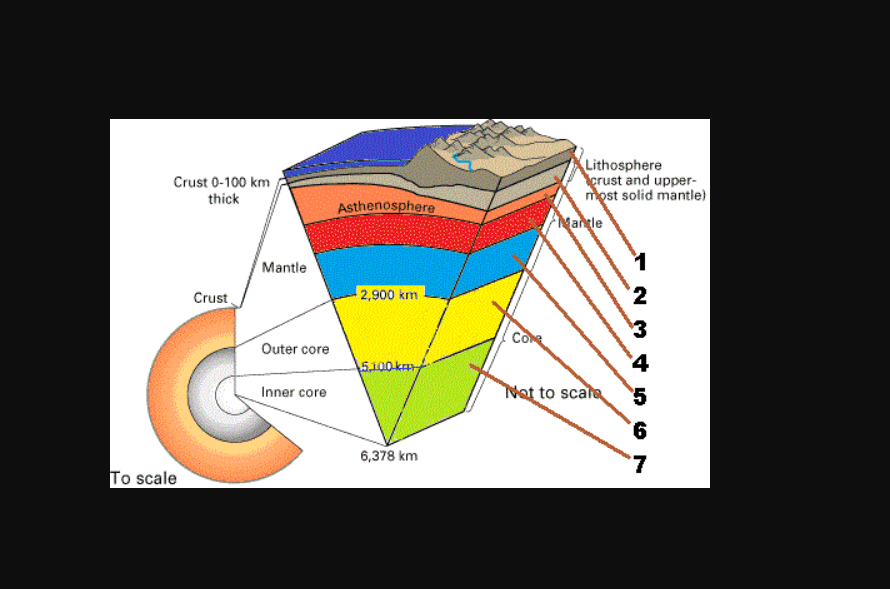
- 1. Crust (0–70 km): The outermost solid layer, composed of continental (thicker) and oceanic (thinner) rock.
- 2. Lithosphere (0–200 km): The rigid, brittle outer shell composed of the crust and the topmost part of the mantle, broken into tectonic plates.
- 3. Asthenosphere (~100–400 km): The upper mantle directly below the lithosphere; a solid, ductile layer that flows slowly, allowing tectonic plates to move.
- 4. Upper Mantle (~400–670 km): A denser, solid region of the mantle beneath the asthenosphere.
- 5. Lower Mantle (670–2,900 km): The hottest part of the mantle, which remains solid due to immense pressure.
- 6. Outer Core (2,900–5,100 km): A liquid layer composed of molten iron and nickel, responsible for generating the Earth’s magnetic field.
- 7. Inner Core (5,100–6,378 km): The solid, incredibly hot central metallic ball (iron/nickel) with temperatures similar to the sun’s surface
4-Seven Layers of the Brain
To understand how the human brain is protected, it is helpful to imagine it like a precious jewel stored inside a series of increasingly soft, shock-absorbing vaults. Nature has designed a sophisticated multi-layered system to ensure that our most vital organ remains safe from impact, infection, and pressure changes.
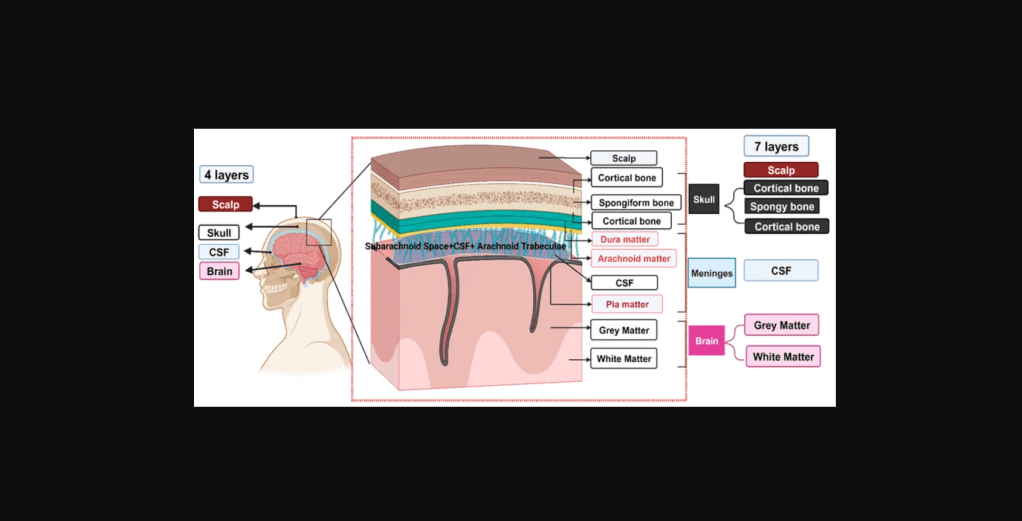
1. The Scalp
The outermost layer is the scalp, which acts as the first line of defence. It consists of skin, connective tissue, and a thin layer of muscle. Its primary job is to cushion the skull against minor bumps and to help regulate the temperature of the head.
2. Cortical Bone (Outer Table)
Beneath the scalp lies the skull. The skull is not a solid, uniform block; it is a “sandwich” of bone. The outer layer, known as the outer table of cortical bone, is hard, dense, and smooth. It provides the rigid structure necessary to protect the brain from external trauma.
3. Spongy Bone (Diploe)
Sandwiched between the two hard layers of the skull is the spongy bone, often called the diploe. This layer is porous and honeycomb-like. It is incredibly important because it acts as a shock absorber, dispersing the force of impacts so that they do not travel directly through to the brain.
4. Cortical Bone (Inner Table)
The inner layer of the skull is the inner table of cortical bone. Like the outer table, it is dense and hard. It serves as the final bony boundary, creating a smooth, protective inner surface that houses the brain and its delicate coverings.
5. Meninges and CSF
Between the bone and the brain tissue lie the meninges—three protective membranes—and the Cerebrospinal Fluid (CSF). The CSF is a clear, watery liquid that circulates around the brain and spinal cord. It acts as a “water cushion,” allowing the brain to float, which reduces its effective weight and protects it from hitting the inside of the skull during sudden movements.
6. Grey Matter
Once you pass the protective layers, you reach the brain itself. The outer surface of the brain is the grey matter. This is where the “thinking” happens. It contains the cell bodies of neurons and is responsible for muscle control, sensory perception, and decision-making.
7. White Matter
Deep beneath the grey matter lies the white matter. It is composed of long, insulated nerve fibres (axons) that act like a complex wiring system. These fibres connect different parts of the grey matter to each other, allowing the brain to communicate across its various regions at lightning speed.
The Development of the Brain
It is essential to distinguish between the formation of the brain’s structure and its functional maturation. The brain is never truly “complete” in the sense of being a static organ; rather, it undergoes continuous development throughout the lifespan.
The structural foundation of the brain is established during Neurulation (Step 6) and continues through Organogenesis (Step 7). However, the cellular processes that build the brain—neurogenesis, migration, differentiation, maturation, synaptogenesis, pruning, and myelination—extend well into early adulthood.
While the basic architecture is laid down in the embryonic period, the prefrontal cortex, which governs executive function, does not reach full structural maturity until the mid-twenties.
Therefore, while the brain is “formed” during the embryonic stages, it remains a dynamic, evolving organ for decades
The exploration of the human brain and the significance of the number seven in Islamic intellectual history represents a convergence of classical theology, early neuroscience, and cosmology. Islamic scholars have long engaged with the concept of the “soul” (nafs) and the “intellect” (‘aql), often situating these faculties within the physical structure of the brain, while simultaneously viewing the number seven as a divinely ordained structural constant in both the macrocosm and the human microcosm.
The Brain and the Faculty of Intellect in Islamic Thought
Classical Islamic scholars, particularly those influenced by Galenic medicine and Aristotelian philosophy, viewed the brain as the seat of the rational soul. In The Canon of Medicine, Ibn Sina (Avicenna) provided a detailed anatomical description of the brain, identifying the ventricles as the locations for various cognitive functions, such as imagination, memory, and common sense.
Scholars like Al-Ghazali, in his work The Revival of the Religious Sciences (Ihya’ ‘Ulum al-Din), distinguished between the physical brain (dimagh) and the metaphysical intellect (‘aql), arguing that while the brain serves as the instrument for the soul, the intellect is a light cast into the heart by God.
This dualistic approach allowed scholars to reconcile empirical observations of brain injury with the theological necessity of the soul’s independence.
The Significance of the Number Seven
The number seven is frequently cited in Islamic literature as a “perfect” or “comprehensive” number. Ibn al-Qayyim al-Jawziyya, in his seminal work Zaad al-Ma’aad, emphasizes that the number seven governs both the physical creation and the religious law (shari’ah).
He notes that there are seven heavens, seven earths, and seven days of the week, suggesting that human physiology and spiritual development are aligned with these celestial patterns.
Regarding the “seven levels” of the brain or the soul, Islamic psychology—often termed ‘Ilm al-Nafs—frequently categorizes the development of the human self into seven distinct stages or “levels” of the nafs. These are typically identified as:
- Nafs al-Ammara (The Commanding Self)
- Nafs al-Lawwama (The Self-Accusing Self)
- Nafs al-Mulhama (The Inspired Self)
- Nafs al-Mutma’inna (The Tranquil Self)
- Nafs al-Radiyya (The Contented Self)
- Nafs al-Mardiyya (The Pleasing Self)
- Nafs al-Kamila (The Perfected Self)
These stages, discussed extensively by Sufi scholars such as Al-Sulami and later synthesized in works like The Alchemy of Happiness, represent the spiritual evolution of the human consciousness.
While these are not “levels of the brain” in a modern neuroanatomical sense, they represent the “levels of the human experience” as processed through the intellect and the heart.
Synthesis of Cosmology and Physiology
The connection between the number seven and the human body is further explored in the tradition of ‘Ilm al-Huruf (the science of letters and numbers). Scholars argued that just as the heavens are seven, the human head contains seven primary openings (two eyes, two ears, two nostrils, and the mouth), which serve as the sensory gateways for the brain to perceive the world.
This structural symmetry was seen as evidence of the mizan (balance) inherent in creation, a concept deeply rooted in Quranic exegesis.
Modern academic studies on Islamic intellectual history confirm that this preoccupation with the number seven was not merely superstitious but was a systematic attempt to map the human experience onto a divinely ordered universe.
5- Seven Layers of the Universe
Author’s Opinion
Allah Knows Best as perhaps the Cosmos is made up of 7 heavens or Firmaments. Our Visible Universe is in the First Heaven, which may also contain 7 Universes (or Multiple Universes) No one truly knows about the Heavens except for the Hadith of Prophet Muhammad concerning Israa and Mi’raj, which describes his miraculous night journey from Mecca to Jerusalem and then through the heavens.
Quran Chapter 67 Verse 3
ٱلَّذِى خَلَقَ سَبۡعَ سَمَـٰوَٲتٍ۬ طِبَاقً۬اۖ مَّا تَرَىٰ فِى خَلۡقِ ٱلرَّحۡمَـٰنِ مِن تَفَـٰوُتٍ۬ۖ فَٱرۡجِعِ ٱلۡبَصَرَ هَلۡ تَرَىٰ مِن فُطُورٍ۬ (٣)
Translation
It is He who has created seven heavens, one above the other. You can see no flaw in the creation of the Beneficent God. Look again. Can you see faults?
The Earth is wrapped in a protective blanket of gases called the atmosphere. Think of it like a multi-layered onion, where each layer has a special job to keep us safe and comfortable.
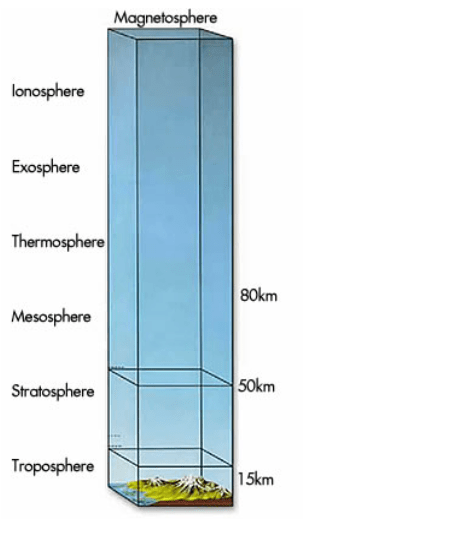
The 7 Layers of the Atmosphere
1. Troposphere (0 to 10–15 km) This is the layer where we live, breathe, and where all our weather happens—rain, snow, and clouds.[3] [4] It is the densest layer, containing most of the air we need to survive. As you go higher, the air gets colder.
2. Stratosphere (15 to 50 km) Above the troposphere lies the stratosphere. This is where airplanes fly to avoid the bumpy weather below.[6] It contains the ozone layer, which acts like a pair of sunglasses for Earth, blocking harmful ultraviolet (UV) rays from the Sun.
3. Mesosphere (50 to 85 km) The mesosphere is the “middle” layer. It is very cold—the coldest place in the atmosphere! This is the layer where most meteors burn up when they enter our atmosphere, creating what we call “shooting stars.”
4. Thermosphere (85 to 600 km) In the thermosphere, the air is extremely thin. Temperatures here can soar to thousands of degrees because it absorbs high-energy radiation from the Sun, though it would feel cold to us because there are so few molecules to touch our skin.
5. Exosphere (600 to 10,000 km) This is the final frontier before space. It is where our satellites orbit the Earth. The air is so thin here that atoms and molecules can escape into outer space.
6. Ionosphere (60 to 1,000 km) The ionosphere is not a separate layer like the others; it is a region that overlaps the mesosphere and thermosphere. It is filled with electrically charged particles (ions) created by the Sun’s energy. This layer is vital because it reflects radio waves, allowing us to communicate across long distances.
7. Magnetosphere (1,000 km and beyond) The magnetosphere is the Earth’s magnetic shield. It is shaped by the Earth’s magnetic field and protects us from dangerous solar winds that could strip away our atmosphere
6-Structural Similarities Between The Quran, Human Brain and The Universe
The Quran features profound interconnectedness, where verses, themes, and phrases mirror each other across different surahs, creating a web of meaning.
The Quran: A Beautiful Web of Connections
Imagine a spider’s web. Each thread is carefully connected to another. If you touch one part, the whole web gently moves together. The Quran is like that web. It is not just a book with separate chapters. Instead, it is a deeply connected message where verses, ideas, and words are linked in amazing ways.
When we read many books, the story goes in a straight line—beginning, middle, and end but the Quran is different. A topic might appear in one chapter (called a Surah) then appear again in another chapter sometimes the same idea is explained in a new way. Words and themes repeat to remind us of important lessons. It’s like threads crossing each other—forming a strong and meaningful web.
A spider’s web is: Strong, Balanced and Carefully designed.
The Quran is similar: Every part supports another part. Nothing is random. Everything has meaning and purpose and this shows the beauty and depth of the Quran. When we understand the Quran as a web:
We don’t just read one verse alone. We try to see how it connects to others and we understand the message more deeply. It teaches us that:
Truth is not always in one place—it is found by connecting ideas together.
Each verse = One thread. / Each Surah = A group of threads. / The whole Quran = One complete web. /All connected. All meaningful.
Examples of These Connections
Here are a few simple ways the Quran connects its messages:
1. Repeated Stories with New Lessons
Stories of prophets appear in different places.
For example:
- The story of Prophet Musa (Moses) is told in many Surahs
- Each time, it highlights a different lesson (patience, courage, trust in God)
This is like looking at the same picture from different angles.
2. Themes That Link Together
Big ideas appear again and again, such as:
- Kindness
- Justice
- Belief in one God
- Helping others
Even if the verses are far apart, they are connected by the same message.
3. Words That Repeat for Meaning
Certain important words are repeated across the Quran, like:
- Mercy
- Guidance
- Truth
This repetition helps us remember what is important.
4. Beginning and Ending Connections
Sometimes: The beginning of a Surah connects to its ending and one Surah connects to the next Surah. It’s like the threads of a web looping back and joining each other.
Conclusion
The Quran is not just a book to read once and finish. It is a living web of guidance. The more you explore it, the more connections you discover—just like looking closely at a spider’s web and seeing how beautifully it is made.
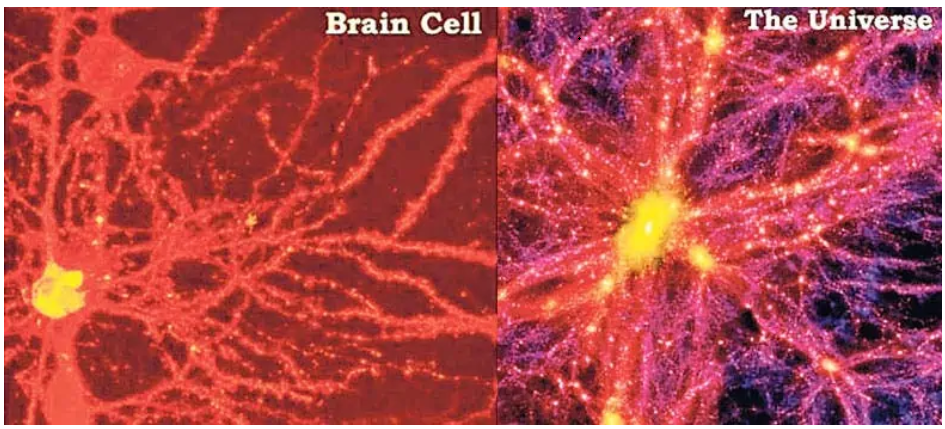
The human brain and the cosmos share striking structural similarities, with the brain’s neural networks and the universe’s cosmic web both forming web-like structures with similar connectivity patterns, despite a 27-order-of-magnitude scale difference. Both systems consist of roughly 100 billion nodes (neurons vs. galaxies) that utilize similar networking principles for communication, suggesting shared laws of self-organization, though they operate via different physical mechanisms.
Key Parallels in Structure and Function
Networking Architecture: The brain’s neuronal network and the cosmic web (filaments of dark matter connecting galaxy clusters) share similar, non-random patterns of interconnectivity.
Similar Ratios: A 2020 study found that both systems consist of roughly 75-80% “passive” material (water in the brain, dark energy in the cosmos) and 20-25% “active” components (neurons/galaxies) forming filaments.
Information Processing: Both systems appear to have comparable information storage/flow capacity, where nodes connect via filaments to transmit signals.
Fractal Patterns: Both systems grow and organize using fractal structures, where patterns repeat at different scales.
Speculative and Theoretical Connections
Quantum Consciousness: Some researchers propose a quantum connection, suggesting that brain neurons, which communicate through electrical impulses, may also exhibit quantum behavior, potentially linking cognitive processes to the fundamental fabric of the universe.
Cosmic Model: Some studies suggest that the neocortex’s structure and dynamics act as a model for the quantum-causal network of spacetime.
Panpsychism: The structural similarity has led some scientists to explore the concept of a self-organizing universe, with a few exploring the fringe, non-mainstream concept that the cosmos itself is a “giant brain
The universe is like a giant cosmic construction set, built from tiny pieces that come together to form everything we see, from the smallest grain of sand to the largest galaxy. At the very beginning, during the Big Bang, the universe was just a tiny, super-hot point of energy.
As it expanded and cooled, this energy turned into the basic ingredients that make up all matter.
Scientists study these building blocks to understand how the cosmos evolved over 13.7 billion years.
To understand how the universe is put together, we can look at these building blocks in order of size, starting from the tiniest particles and moving up to the massive structures that fill the night sky.
- Subatomic Particles: Everything starts with tiny particles like protons, neutrons, and electrons. These are the “bricks” that make up atoms.
- Atoms: When these particles join together, they form atoms, such as Hydrogen and Helium. Atoms are the basic units of all chemical elements.
- Molecules: When atoms link up, they create molecules. For example, two hydrogen atoms and one oxygen atom make a water molecule ().
- Dust and Gas: In space, huge clouds of gas and dust (called nebulae) float around. These are the nurseries where new stars are born.
- Stars: Stars are giant balls of burning gas, mostly hydrogen, held together by gravity. They create heat and light through a process called nuclear fusion.
- Planets: Planets are large bodies that orbit stars. They are made of rock, metal, or gas that clumped together from the leftover material of a star’s birth.
- Asteroids and Comets: These are smaller “leftover” pieces from the early solar system. Asteroids are mostly rocky or metallic, while comets are like “dirty snowballs” made of ice and dust.
- Solar Systems: A solar system consists of a star and everything that orbits it, including planets, moons, asteroids, and comets.
- Galaxies: A galaxy is a massive collection of billions of stars, gas, dust, and dark matter, all held together by gravity. Our home is the Milky Way.[9]
- The Universe: This is everything that exists—all space, time, matter, and energy combined into one giant structure.
7-The Seven Stages of Human Embryological Development
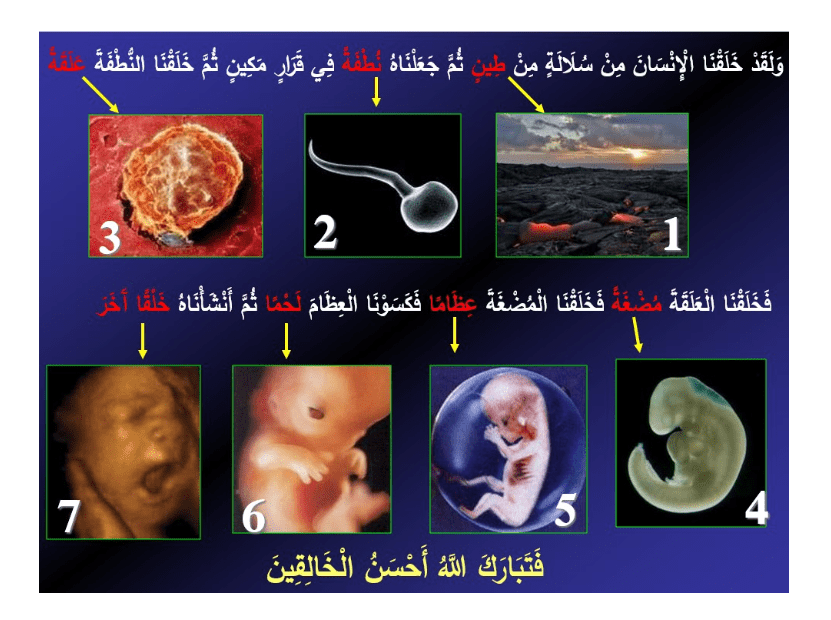
سُوۡرَةُ المؤمنون Chapter 23 Verses 12-14
وَلَقَدۡ خَلَقۡنَا ٱلۡإِنسَـٰنَ مِن سُلَـٰلَةٍ۬ مِّن طِينٍ۬ (١٢) ثُمَّ جَعَلۡنَـٰهُ نُطۡفَةً۬ فِى قَرَارٍ۬ مَّكِينٍ۬ (١٣) ثُمَّ خَلَقۡنَا ٱلنُّطۡفَةَ عَلَقَةً۬ فَخَلَقۡنَا ٱلۡعَلَقَةَ مُضۡغَةً۬ فَخَلَقۡنَا ٱلۡمُضۡغَةَ عِظَـٰمً۬ا فَكَسَوۡنَا ٱلۡعِظَـٰمَ لَحۡمً۬ا ثُمَّ أَنشَأۡنَـٰهُ خَلۡقًا ءَاخَرَۚ فَتَبَارَكَ ٱللَّهُ أَحۡسَنُ ٱلۡخَـٰلِقِينَ (١٤)
Translation
And certainly did We create man from an extract of clay/Then We placed him as a sperm-drop in a firm lodging./Then We made the sperm-drop into a clinging clot, and We made the clot into a lump [of flesh], and We made [from] the lump, bones, and We covered the bones with flesh; then We developed him into another creation. So blessed is Allah , the best of creators.
1-Clay 2-Sperm Drop 3-Clinging Clot 4-Lump of Flesh 5-Bones 6-Bones covered with flesh 7-New Creation
The development of a human being from a single-celled zygote to a complex organism is a highly orchestrated biological process involving precise cellular and molecular events. While embryologists often categorize development into various phases depending on the level of detail required, the process is generally understood through seven foundational stages of embryogenesis.
- Fertilisation: The process begins when a sperm cell penetrates an ovum, creating a diploid zygote. This fusion restores the full complement of human chromosomes.
- Cleavage: The zygote undergoes rapid mitotic divisions without increasing in total size, transforming into a solid ball of cells known as a morula.
- Blastulation: The morula develops into a blastocyst, characterized by an inner cell mass (which becomes the embryo) and an outer layer called the trophoblast (which contributes to the placenta).
- Implantation: The blastocyst attaches to and embeds within the uterine wall, establishing a connection with the maternal circulatory system.
- Gastrulation: This is a critical period where the blastocyst reorganizes into a trilaminar structure consisting of three primary germ layers: the ectoderm, mesoderm, and endoderm, which serve as the precursors to all tissues and organs.
- Neurulation: The ectoderm folds to form the neural tube, which is the precursor to the central nervous system, including the brain and spinal cord.
- Organogenesis: During this stage, the germ layers differentiate into specific organ systems. The body plan is established, and the internal organs begin to take their functional form.
8-Summary
The similarities between all these structures prove beyond doubt that Allah is the only one who is the true creator, demonstrating a harmony that unites them in purpose and design. Each of these intricate designs, whether found in nature or human creations, points to His uniqueness and unparalleled power, illustrating the profound wisdom embedded in all aspects of existence. It is a testament to the divine craftsmanship that we witness throughout the universe, from the vastness of the cosmos to the minutest details in life. In moments of reflection and awe, we find ourselves utterly humbled, acknowledging that we have nothing to say except, “God is Great,” as we declare, “Allahu Akbar.” This profound recognition fills our hearts with gratitude and reverence for the Creator who has shaped everything around us.
Inshaaalllah (If Allah Wills), more topics coming soon.
 SCIENTIFIC AND ISLAMIC RESEARCHES